Weakness: what it usually turns out to be
“দুর্বলতা” is the commonest thing patients say and the least informative thing they can say. It is not a diagnosis, it is a container — and several quite different illnesses arrive inside it. This page sets out what is actually found, in the order it is found here.
‘দুর্বলতা’ কোনো রোগ নয় — একটি শব্দ, যার ভিতরে বেশ কয়েকটি আলাদা রোগ লুকিয়ে থাকতে পারে। এখানে কোন ক্রমে কী পাওয়া যায়, তা নীচে দেওয়া হল।
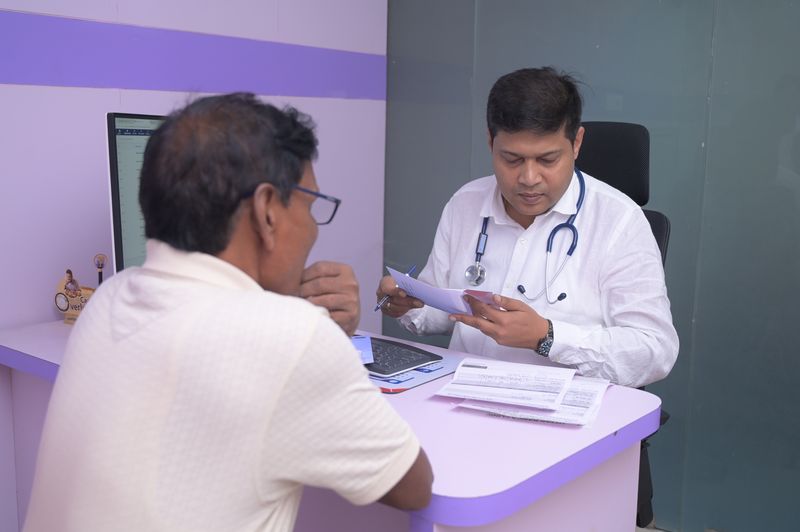
Weakness is a symptom with a wide differential, and it is assessed by working through the causes in order of how often they turn out to be responsible. At Uttarbanga Clinic that order is: anaemia; uncontrolled diabetes; cardiac dysfunction and obstructive lung disease; thyroid disease; vertigo being described as weakness; exertional breathlessness being described as weakness; and vitamin B12 or other vitamin deficiency. A defined blood panel — full blood count, iron studies, thyroid function, HbA1c, vitamin B12 and D, kidney and liver function — answers most of it, and examination and an ECG answer much of the rest. A tonic or a haematinic prescribed without establishing the cause treats none of them. Dr Soumya Ghosh, MD (General Medicine), assesses weakness at Uttarbanga Clinic, Sunity Road, Cooch Behar.
Do not wait for an appointment if any of these apply
- Sudden weakness of one side of the body, a drooping face, difficulty speaking, or sudden loss of vision. This is a stroke.
- Weakness with breathlessness at rest or chest discomfort.
- Weakness with fainting or near-fainting.
- Weakness with black stools or visible bleeding.
- Weakness with unintentional weight loss, or with fever lasting more than a week.
- Weakness that has come on over days rather than months.
Call 108 or go directly to the emergency department at MJN Medical College & Hospital, Cooch Behar. Do not drive yourself.
In a suspected stroke, treatment works best within the first four and a half hours. Note the time the symptoms started.
Key facts
- Anaemia is the commonest finding — 57.2% of Indian women aged 15–49 and 25.0% of men are anaemic (NFHS-5).
- But iron deficiency accounts for less than a third of Indian anaemia, so iron given on assumption often does nothing.
- In eastern India, β-thalassaemia trait runs at about 4.6% and haemoglobin E trait at about 3.0%. A small red cell in a Bengali patient is not automatically iron deficiency.
- Of 621 haematinic preparations on the Indian market, only 24% were judged rational — 81% of oral solid formulations were not.
- 72% of heart failure patients are diagnosed only during a hospital admission, after a median of seven months of symptoms that they had attributed to ageing.
- Hypothyroidism affects about 10.95% of Indian adults — 15.86% of women against 5.02% of men — with a further 8.02% subclinical.
- Vertigo is routinely mistreated: of people with benign positional vertigo, 78% consulted a doctor, but only 10% received a positioning manoeuvre and only 8% received effective treatment.
- Long-term metformin and long-term acid-suppressing medicines both lower vitamin B12 — two years or more of a proton pump inhibitor carries an odds ratio of 1.65.
The word is the problem
In this clinic, দুর্বলতা is the single commonest thing a patient says on sitting down. It is also, on its own, close to useless diagnostically — not because patients describe things badly, but because Bengali uses one word for a range of sensations that medicine treats as entirely separate problems.
Two examples make the point, and both come up most weeks. A patient who says they feel weak, questioned properly, turns out to have vertigo — the room moves when they turn over in bed — which they had not mentioned because it did not seem like the main thing. Another turns out to have breathlessness on exertion: they can no longer climb the stairs to the first floor without stopping. Neither said “dizzy” and neither said “breathless”. Both said weak.
So the first part of the consultation is not testing. It is finding out which symptom is actually being described.
What it turns out to be, in order
The list below is the order in which these actually turn out to be the answer in this practice, which is not the order a textbook would give. It is worth stating as an order rather than a list, because it is what determines which test gets done first.
| # | Cause | What usually settles it |
|---|---|---|
| 1 | Anaemia | Full blood count, peripheral smear, ferritin — and often HPLC |
| 2 | Uncontrolled diabetes | HbA1c and fasting glucose |
| 3 | Cardiac dysfunction and obstructive lung disease | Examination, ECG, chest imaging, spirometry, echocardiography referral |
| 4 | Thyroid disease | TSH, with free T4 where indicated |
| 5 | Vertigo described as weakness | History and positional testing at the bedside |
| 6 | Exertional breathlessness described as weakness | Exercise history, then as row 3 |
| 7 | Vitamin B12 and other vitamin deficiency | Serum B12, 25-hydroxy vitamin D |
Rows 3 and 6 are the same diseases seen from two directions, and they are separated deliberately. Row 3 is how often heart and lung disease turn out to be the cause. Row 6 is how often the patient had the specific symptom of exertional breathlessness and called it weakness instead. The second is why the first is missed.
1. Anaemia — and why iron is often the wrong answer
Anaemia is first because it is genuinely common. India's National Family Health Survey found 57.2% of women aged 15 to 49 anaemic, along with 52.2% of pregnant women, 59.1% of adolescent girls and 25.0% of men.[1]
Now the part that changes treatment, and it is the reason this section exists. Iron deficiency is not the cause of most Indian anaemia. A study measuring venous blood across eight states found that iron-deficiency anaemia accounted for less than a third of total anaemia in every group examined, reaching around 45% only in adolescent girls; in the authors' words, the major proportion in all groups was associated with other causes.[2] The same study found venous haemoglobin gives substantially lower anaemia prevalence than the finger-prick method used in national surveys — 41% in adult women rather than 57%.
And in Bengal specifically there is a second reason not to assume iron. Across 119,336 samples analysed by HPLC in eastern India, β-thalassaemia trait was present in 4.60% and haemoglobin E trait in 3.02%, with HbE–β-thalassaemia in a further 1.16%.[3] A community antenatal sample in Kolkata found β-thalassaemia trait in 4.61%.[4] Both thalassaemia trait and iron deficiency produce small, pale red cells on a blood count. They are not treated the same way, and iron given to someone with thalassaemia trait does nothing useful and can cause iron overload if repeated for years.
So a low haemoglobin with a low MCV in a Bengali patient is a question, not an answer. Ferritin distinguishes most of it; HPLC settles the rest.
- Thalassaemia trait
- Carrying one gene for thalassaemia. It causes small red cells and a mildly low haemoglobin lifelong, causes no symptoms of its own, and needs no treatment. It matters for two reasons: it is mistaken for iron deficiency and treated with years of useless iron, and if both parents carry it there is a one in four chance in each pregnancy of a child with transfusion-dependent thalassaemia major.
- Ferritin
- The body's stored iron. It is the test that separates iron deficiency from other causes of small red cells. One caution: ferritin rises during any inflammation or infection, so a normal ferritin in someone who is acutely unwell does not exclude iron deficiency.
One further point, which is why the cause matters rather than just the number. Iron deficiency in an adult without an obvious dietary or menstrual explanation is a finding that needs its own investigation: in secondary-care series, 7.7% of patients with iron-deficiency anaemia turned out to have a gastrointestinal malignancy.[5] Correcting the haemoglobin without asking where the iron went can bury the diagnosis for a year.
2. Uncontrolled diabetes
Second on the list because it is common, easily tested and frequently the whole explanation. India has an estimated 101 million adults with diabetes,[6] and sustained high blood glucose produces exactly the picture patients describe as weakness: tiredness that does not lift with rest, weight loss despite eating, thirst, passing urine at night, and blurred vision that comes and goes.
Two patterns worth naming. Someone who has never been tested, presenting only with months of weakness, in whom the HbA1c is the diagnosis. And someone already on treatment whose weakness is the first sign that control has slipped — which is why an HbA1c is checked rather than assumed from the last reading.
3. Cardiac dysfunction and obstructive lung disease
These sit third, above thyroid, and that placement is deliberate. Heart failure and chronic obstructive lung disease are common in this population and both are routinely reported as weakness rather than as breathlessness — because the patient has adapted. They stopped climbing the stairs, stopped walking to the market, and what they notice is not that breathing is hard but that they can do less.
The evidence for how badly this is missed is striking. In a primary-care cohort, 72% of heart failure patients were diagnosed only during a hospital admission, after a median of seven months of symptoms — and the authors recorded that patients had attributed those symptoms to ageing or to their other conditions rather than to the heart.[7] Fatigue was reported by 67% of them, breathlessness by 78% and ankle swelling by 44%. That is a UK cohort, so treat the proportions as indicative; the mechanism — symptoms attributed to age and reported as tiredness — is exactly what is seen here.
What is done about it costs nothing: asking specifically what the person can no longer do, examining for raised venous pressure, crackles, an added heart sound and ankle oedema, and an ECG in the same visit. Where it points that way, chest imaging, spirometry and an echocardiography referral follow.
Obstructive lung disease deserves its own mention here because of how it arises in this district — years of cooking over biomass and years of smoking both produce it, and both are often not volunteered unless asked directly.
4. Thyroid disease
Hypothyroidism is common enough to test for routinely: an eight-city Indian study of 5,360 adults found it in 10.95%, of which about a third was previously undetected, with a further 8.02% subclinical. It was three times commoner in women than men — 15.86% against 5.02% — and anti-TPO antibodies were present in 21.85%.[8] That was an urban screening sample rather than a national estimate, so read it as an indication of scale.
The reason it sits fourth rather than first, despite being the cause everyone thinks of, is simply that the three above it are found more often. It is still tested in the first panel, because a TSH is inexpensive and the treatment is straightforward.
5. Vertigo, arriving as weakness
This is where the consultation earns its keep, because the whole problem is one of translation. The patient says weak. The history — asked for specifically — is that the room spins for a few seconds when they turn over in bed, sit up, or look up at a shelf. That is benign paroxysmal positional vertigo, and it is diagnosed at the bedside with a positional test and often treated in the same visit with a repositioning manoeuvre.
Two things are worth knowing about how this usually goes elsewhere. First, it is routinely mistreated. In a population study of people with this condition, 78% had consulted a doctor — but 45% received no treatment at all, 27% were given drugs for vertigo, only 10% received a positioning manoeuvre, and only 8% received effective treatment.[9] In a series of patients who eventually reached a specialist balance clinic, 61% had already had more than two primary-care consultations, 76% had had an MRI scan, a quarter had been given betahistine, and repositioning manoeuvres appeared nowhere in the primary-care record.[10]
Second, the manoeuvre works, though not as well as the figure people quote. A Cochrane review of 11 trials found complete resolution of vertigo in 56% after the Epley manoeuvre against 21% with sham or no treatment, an odds ratio of 4.42.[11] The commonly repeated “80% cured in one visit” has no traceable source. A real 21-to-56 percentage-point shift, from a manoeuvre that takes two minutes and costs nothing, is worth having on its own terms.
Not all dizziness is benign, and age matters. Among dizziness presentations, dangerous underlying disorders were found in 15% overall — 20.9% in those over 50 against 9.3% in those under — and about a fifth of dizziness presentations were cardiovascular rather than inner-ear in origin.[12] So dizziness with weakness on one side, difficulty speaking, double vision, a severe headache, or fainting is assessed as an emergency, not as vertigo.
6. Exertional breathlessness, arriving as weakness
The same translation problem as vertigo, and clinically more consequential. The question that opens it is not “are you breathless” — the answer is usually no — but what can you no longer do that you could do six months ago. The answers that matter: stopping halfway up the stairs, no longer walking to the market, sleeping propped on more pillows than before, waking at night short of breath.
Where that history is present, the assessment is the one in section 3, and it is not deferred. New exertional breathlessness in a person with diabetes or high blood pressure is one of the more important things this clinic looks for, because it is the point at which heart failure is still early.
7. Vitamin B12 and other deficiencies
Last on the list, which is not to say unimportant — it is to say that it is where people usually start, and starting there is why the rest gets missed.
Vitamin B12 deficiency is worth testing for, and there are two causes that are systematically overlooked because they are iatrogenic. Long-term metformin lowers B12: in a long-running trial cohort the odds of low B12 rose by 13% for each year of metformin use, and at five years low or borderline levels were present in 19.1% of metformin users against 9.5% of controls.[13] Long-term acid-suppressing medicines do the same: two years or more of a proton pump inhibitor carried an odds ratio of 1.65 for B12 deficiency, rising to 1.95 at higher doses.[14] Both effect sizes come from Western cohorts, but the drugs and the mechanism are the same everywhere — and between them they describe a very large number of patients in this clinic, since long-term metformin and long-term acidity medicines are two of the commonest prescriptions in the district.
Vitamin D is tested too, and here it is worth being honest about the evidence rather than repeating the usual figure. The best pooled estimate for deficiency in Indian adults is about 67%, but the studies behind it are overwhelmingly urban clinic samples with enormous variation between them, and there is no nationally representative survey of vitamin D in Indian adults at all.[15] The widely quoted 70 to 80% comes from a narrative review rather than a measurement. The level is measured before treating because the dose and duration depend on how low it is, and because unmeasured supplementation can raise calcium and cause stones.
Why a tonic is not the answer
The default treatment for weakness in India is a haematinic or multivitamin syrup, and it is worth explaining why this clinic does not start there.
An analysis of 621 haematinic preparations available on the Indian market found only 24% to be rational — 81% of oral solid formulations and 75% of oral liquids were not. Sixty formulations contained less than 33 mg of elemental iron per dose, meaning three or more doses a day would be needed to deliver a therapeutic amount, and many carried additional ingredients that the authors described as having nothing to do with blood formation. The rational preparations cost more than the irrational ones.[16]
So the objection is not philosophical. A tonic that contains too little iron to treat iron deficiency, given to someone whose anaemia is not iron deficiency in the first place, for a symptom that is actually early heart failure, is three failures stacked on top of each other — and the patient feels no better, concludes that nothing works, and comes back six months later.
Where a deficiency is demonstrated, it is replaced properly, at an adequate dose, for an adequate duration, and the level is rechecked.
How much testing is justified
An honest complication, because there is good evidence pointing the other way and it should not be hidden.
The best systematic review of tiredness in general practice found that serious organic disease explained only 4.3% of cases, with anaemia in 2.8% and malignancy in 0.6% — while depression accounted for 18.5%. The authors concluded that extensive investigation is justified only when the history or examination points somewhere, and that attention is better directed at mood and circumstances.[17]
That finding is sound and it does not transfer here unchanged. It comes from Western primary care, where background anaemia prevalence is low. In a district where 57% of women are anaemic, a haemoglobin is a far higher-yield test than the same test in Germany, and the same is true of an HbA1c in a country with 101 million people with diabetes. The panel used here is wider than that review would suggest, and the reason is the population, not enthusiasm for testing.
What does transfer is the second half of the conclusion. Low mood, poor sleep, grief, financial strain and caring for an unwell relative all produce genuine physical exhaustion, and they are asked about — not as a diagnosis of exclusion once the tests come back normal, but as part of the same conversation.
When weakness needs seeing sooner
Most weakness is not urgent. These are the exceptions.
Sudden weakness of one side of the body, difficulty speaking, drooping of one side of the face, or sudden loss of vision — this is a stroke, and it is an emergency. Call 108 and go directly to hospital; do not wait for an appointment.
Also needing prompt assessment rather than a routine appointment: weakness with breathlessness at rest or chest discomfort; weakness with fainting or near-fainting; weakness with black stools or visible bleeding; weakness with unintentional weight loss, particularly more than about 5% of body weight in six months; weakness with fever lasting more than a week; and weakness that has come on rapidly over days rather than gradually over months.
And one that is easy to dismiss: weakness in someone taking several regular medicines, which is often the medicines themselves. Bring every strip.
সংক্ষেপে (বাংলায়)
‘দুর্বলতা’ শব্দটি একাই অনেক কিছু ঢেকে রাখে — এবং কাজ হল তার ভিতরে কোনটি লুকিয়ে আছে তা বের করা। কোচবিহারে যে ক্রমে কারণগুলি বেরিয়ে আসে: রক্তাল্পতা, অনিয়ন্ত্রিত ডায়াবেটিস, হৃদযন্ত্রের দুর্বলতা ও ফুসফুসের বাধাজনিত রোগ, থাইরয়েড, মাথা ঘোরা, পরিশ্রমে শ্বাসকষ্ট, এবং ভিটামিন বি১২ ও অন্যান্য ভিটামিনের ঘাটতি। একটি গুরুত্বপূর্ণ কথা — বাংলায় বহু মানুষের রক্তাল্পতা আয়রনের অভাবে নয়। ভারতে মোট রক্তাল্পতার এক-তৃতীয়াংশেরও কম আয়রনের ঘাটতিজনিত, আর পূর্ব ভারতে থ্যালাসেমিয়া বাহক প্রায় ৪.৬% ও HbE বাহক প্রায় ৩%। তাই কারণ না জেনে শুধু আয়রন বা টনিক খেলে কাজ হয় না, এবং আসল রোগটি ধরা পড়ে না। ভারতের বাজারে থাকা ৬২১টি রক্তবর্ধক ওষুধের মাত্র ২৪% যুক্তিসঙ্গত পাওয়া গেছে। কোচবিহারের উত্তরবঙ্গ ক্লিনিকে ডাঃ সৌম্য ঘোষ দুর্বলতার প্রকৃত কারণ খুঁজে বের করেন।

Written and medically reviewed by Dr Soumya Ghosh, MBBS, MD (General Medicine)
Consultant Physician (Internal Medicine), Uttarbanga Clinic, Cooch Behar · Assistant Professor, Dept. of General Medicine, MJN Medical College & Hospital, Cooch Behar
West Bengal Medical Council Reg. No. 67751 — verify on the Indian Medical Register · ORCID 0009-0004-1686-5540 · Last reviewed
Frequently asked questions
I feel weak all the time. What tests will be done?
A defined panel rather than a random selection: full blood count with a peripheral smear, ferritin and iron studies, HbA1c, thyroid function, vitamin B12 and vitamin D, and kidney and liver function. Alongside that, an examination and usually an ECG, because heart and lung disease are among the commoner causes and are not found on a blood test. The order in which these are interpreted follows what actually turns out to be responsible: anaemia, then uncontrolled diabetes, then cardiac and obstructive lung disease, then thyroid, then vertigo, then exertional breathlessness, then vitamin deficiency.
My haemoglobin is low. Should I just take iron?
Not until it is known why it is low. Iron deficiency accounts for less than a third of anaemia in India, and in Bengal specifically β-thalassaemia trait is present in about 4.6% of people and haemoglobin E trait in about 3.0%. Both of those and iron deficiency produce small pale red cells, but only one of them is treated with iron — and iron taken for years by someone with thalassaemia trait does no good and can cause iron overload. Ferritin sorts out most cases; HPLC settles the rest.
What is thalassaemia trait, and does it need treatment?
It means carrying one thalassaemia gene. It causes small red cells and a mildly low haemoglobin for life, causes no symptoms of its own, and needs no treatment. Two things make it worth knowing about. It is very often mistaken for iron deficiency and treated with years of unnecessary iron. And if both partners carry it, each pregnancy carries a one in four chance of a child with transfusion-dependent thalassaemia — which is why testing a spouse matters when it is found.
Why does the doctor ask what I can no longer do?
Because it is the question that finds heart and lung disease, and asking about breathlessness directly usually does not. People adapt without noticing — they stop climbing to the first floor, stop walking to the market — and then describe the result as weakness rather than as breathlessness. In one primary-care study, 72% of heart failure patients were diagnosed only when they were admitted to hospital, after a median of seven months of symptoms they had put down to ageing.
The room spins when I turn over in bed. Is that related to my weakness?
Very probably it is the weakness. That specific pattern — a few seconds of spinning on turning over, sitting up or looking up — is benign paroxysmal positional vertigo, and many patients describe it as weakness because it is not constant enough to feel like dizziness. It is diagnosed at the bedside with a positional test and often treated in the same visit with a repositioning manoeuvre, which produced complete resolution in 56% of patients against 21% with sham treatment in a Cochrane review.
I was given medicine for vertigo before and it did not help. Why?
Because drugs are the wrong treatment for the commonest kind. In a population study of people with benign positional vertigo, 78% had seen a doctor — but only 10% were given a positioning manoeuvre and only 8% received effective treatment, while 27% were given vertigo drugs. Those drugs suppress the sensation without addressing the cause, which is a displaced crystal in the inner ear that a manoeuvre puts back.
Can my diabetes medicine cause weakness?
It can contribute, indirectly. Long-term metformin lowers vitamin B12 — the odds of a low level rise by about 13% for each year of use — and B12 deficiency causes fatigue, tingling in the hands and feet, and memory difficulty. Long-term acidity medicines do the same, with two or more years of a proton pump inhibitor carrying an odds ratio of 1.65. Neither is a reason to stop the medicine; both are a reason to check the level rather than assume.
Why won't the doctor just prescribe a tonic?
Because most of them do not contain enough of anything to treat a deficiency. An analysis of 621 haematinic preparations on the Indian market found only 24% to be rational; 60 of them contained under 33 mg of elemental iron per dose, so three or more doses a day would be needed to reach a therapeutic amount. A tonic given for weakness that is actually early heart failure, or anaemia that is not iron deficiency, does nothing except delay the diagnosis by a few months.
Could my weakness just be stress or low mood?
It genuinely can, and that is not a lesser explanation. The best systematic review of tiredness in general practice found depression in 18.5% of patients — far more than any single physical cause. Low mood, disturbed sleep, grief, financial strain and caring for someone unwell all produce real physical exhaustion. It is asked about as part of the same conversation rather than offered at the end once the tests come back normal.
When is weakness an emergency?
Sudden weakness of one side of the body, difficulty speaking, drooping of one side of the face or sudden loss of vision is a stroke — call 108 and go straight to hospital. Also needing same-day assessment: weakness with breathlessness at rest or chest discomfort, with fainting, with black stools or visible bleeding, with unintentional weight loss, or coming on rapidly over days rather than gradually over months.
Assessment of weakness with Dr Soumya Ghosh
Uttarbanga Clinic, Sunity Road, near Police Line Chowpathi, Ward 20, Cooch Behar 736101. Monday to Saturday, 10:00–20:00. Walk-in or book ahead.
References and guidelines
- International Institute for Population Sciences. National Family Health Survey (NFHS-5), 2019–21. Anaemia prevalence as reported by the Ministry of Health and Family Welfare. pib.gov.in
- Ghosh S, Laxmaiah A, Chandak GR, et al. Anaemia and iron deficiency in India: a venous blood-based survey. Eur J Clin Nutr 2025;79:443–451. doi:10.1038/s41430-024-01559-w
- Mondal SK, Mandal S. Prevalence of thalassaemia and haemoglobinopathy in eastern India: a 10-year high-performance liquid chromatography study of 119,336 cases. Asian J Transfus Sci 2016;10(1):105–110. Hospital referral series, so an upper bound rather than a community estimate.
- Sur D, Chakravorty R. Prevalence of β-thalassaemia trait and haemoglobin E carrier state among pregnant women in Kolkata. J Hematol 2016;5(3):99–102. doi:10.14740/jh297w
- Broad external validation of a multivariable risk prediction model for gastrointestinal malignancy in iron deficiency anaemia. Combined Oxford and Sheffield cohorts, 1,591 patients. PMC8672477. See also Ko CW, Siddique SM, Patel A, et al. AGA clinical practice guidelines on the gastrointestinal evaluation of iron deficiency anemia. Gastroenterology 2020;159(3):1085–1094.
- Anjana RM, Unnikrishnan R, Deepa M, et al. Metabolic non-communicable disease health report of India (ICMR-INDIAB-17). Lancet Diabetes Endocrinol 2023;11(7):474–489. doi:10.1016/S2213-8587(23)00119-5
- Barber S, et al. Developing core indicators for identifying people at risk of delayed heart failure diagnosis. BMC Prim Care 2025;26. doi:10.1186/s12875-025-03024-4. UK primary care cohort.
- Unnikrishnan AG, Kalra S, Sahay RK, Bantwal G, John M, Tewari N. Prevalence of hypothyroidism in adults: an epidemiological study in eight cities of India. Indian J Endocrinol Metab 2013;17(4):647–652. doi:10.4103/2230-8210.113755. Urban screening sample of 5,360 adults; not a national estimate.
- von Brevern M, Radtke A, Lezius F, et al. Epidemiology of benign paroxysmal positional vertigo: a population-based study. J Neurol Neurosurg Psychiatry 2007;78(7):710–715. doi:10.1136/jnnp.2006.100420
- Grill E, Strupp M, Müller M, et al. Health services utilization of patients with vertigo in primary care. J Neurol 2014;261:1492–1498. doi:10.1007/s00415-014-7367-y
- Hilton MP, Pinder DK. The Epley (canalith repositioning) manoeuvre for benign paroxysmal positional vertigo. Cochrane Database Syst Rev 2014;12:CD003162. doi:10.1002/14651858.CD003162.pub3
- Newman-Toker DE, Hsieh YH, Camargo CA, et al. Spectrum of dizziness visits to US emergency departments. Mayo Clin Proc 2008;83(7):765–775. doi:10.4065/83.7.765
- Aroda VR, Edelstein SL, Goldberg RB, et al. Long-term metformin use and vitamin B12 deficiency in the Diabetes Prevention Program Outcomes Study. J Clin Endocrinol Metab 2016;101(4):1754–1761. doi:10.1210/jc.2015-3754
- Lam JR, Schneider JL, Zhao W, Corley DA. Proton pump inhibitor and histamine 2 receptor antagonist use and vitamin B12 deficiency. JAMA 2013;310(22):2435–2442. doi:10.1001/jama.2013.280490
- Siddiqee MH, Bhattacharjee B, Siddiqi UR, Rahman MM. High prevalence of vitamin D deficiency among the South Asian adult population: a systematic review and meta-analysis. BMC Public Health 2021;21:1823. doi:10.1186/s12889-021-11888-1. Note the very high between-study heterogeneity and the predominance of urban clinic samples.
- Karelia BN, Buch JG. Analysis of haematinic formulations available in the Indian market. J Pharmacol Pharmacother 2012;3(1):35–38. doi:10.4103/0976-500X.92504
- Stadje R, Dornieden K, Baum E, et al. The differential diagnosis of tiredness: a systematic review. BMC Fam Pract 2016;17:147. doi:10.1186/s12875-016-0545-5. Western primary care; see the discussion above on why the yield figures do not transfer directly.
This page is general health information written and reviewed by a registered medical practitioner. It is not medical advice, does not create a doctor–patient relationship, and is not a substitute for consultation with a doctor who has examined you. Diagnosis and treatment are individualised after clinical assessment. Medicines mentioned here are prescription-only and must be taken under medical supervision. See the editorial and medical review policy. Last reviewed .