Breathlessness — what it usually turns out to be
Getting short of breath on the stairs is a question, not a diagnosis. Two things dominate here: anaemia, because of how common it is; and bronchospasm, because it is episodic and the chest sounds perfectly normal at the moment you are being examined.
সিঁড়ি ভাঙতে হাঁপিয়ে যাওয়া — এর পিছনে কী থাকতে পারে, কেন চেম্বারে পরীক্ষা করে সব স্বাভাবিক লাগলেও রোগ থাকতে পারে, আর কখন অপেক্ষা করা চলবে না।
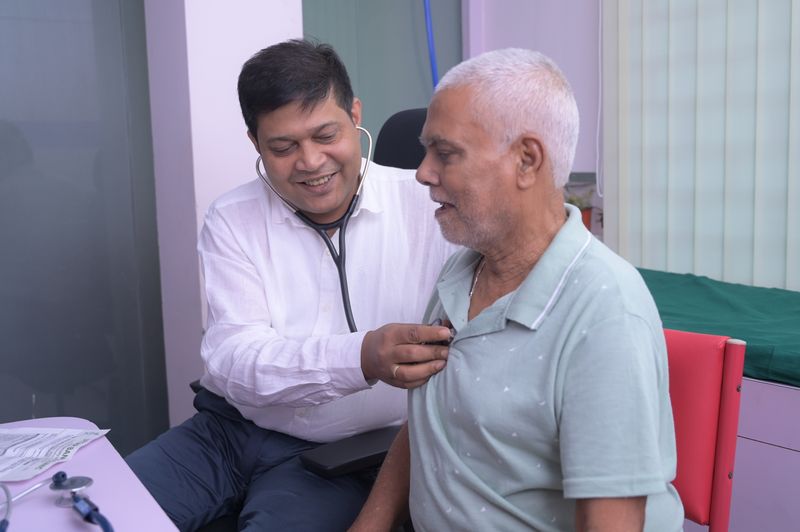
Breathlessness on exertion in an adult is worked through in a set order here: anaemia, then bronchospasm, then the heart, then fixed lung disease, then thyroid overactivity. Anaemia comes first because 71.4% of West Bengal women and 38.9% of men aged 15–49 are anaemic. Bronchospasm comes second because it is the most underdiagnosed — in the Global Asthma Network study, 82% of Indians with current wheeze carried no asthma diagnosis. The reason it is missed is that it is episodic: the chest is clear when the patient is not having symptoms, and a normal examination at the consultation is not a negative result. Bronchodilator reversibility testing has a sensitivity of only 0.25 in adults, and 26% of symptomatic adults with entirely normal spirometry turn out to have asthma on challenge testing. It also presents as chest heaviness, tightness or pain rather than wheeze, which is why these patients are often sent to a cardiologist or treated for gas. Dr Soumya Ghosh, MD (General Medicine), assesses breathlessness at Uttarbanga Clinic, Sunity Road, Cooch Behar.
Do not wait for an appointment if any of these apply
- Breathlessness at rest, or breathlessness that stops you finishing a sentence
- Breathlessness that came on suddenly, over minutes to hours
- Breathlessness with chest pain, sweating or a feeling of collapse
- Breathlessness with one swollen, painful calf
- Breathlessness with blue lips or fingertips, or confusion
- Coughing up blood
- Breathlessness that wakes you from sleep and forces you to sit up
- An asthma attack where the reliever inhaler is not working, or is needed again within a few hours
Call 108 or go directly to the emergency department at MJN Medical College & Hospital, Cooch Behar. Do not drive yourself.
Sudden breathlessness with a swollen calf can be a clot that has travelled to the lung. In one series, 19.5% of pulmonary embolism was not diagnosed at the first assessment, and in-hospital mortality was 43.2% in those diagnosed late against 1.6% in those diagnosed early.
Key facts
- In West Bengal, 71.4% of women and 38.9% of men aged 15–49 are anaemic — which is why a blood count comes before an inhaler.
- 82% of Indians with current wheeze have never been diagnosed with asthma, and 70% of those with symptoms of severe asthma.
- A normal test does not clear you: bronchodilator reversibility has a sensitivity of 0.25 in adults — about three quarters of adults with asthma test negative.
- 26% of symptomatic adults with normal spirometry before and after a bronchodilator had asthma on challenge testing.
- Bronchospasm can present as chest tightness or pain with no wheeze at all: in one series of chest pain variant asthma, 29 of 31 patients had normal or near-normal lung function — and all 31 had a positive challenge test.
What people usually say
Almost nobody arrives saying "I am dyspnoeic on moderate exertion." What is said is that the stairs have become difficult, that the walk to the market now needs a stop halfway, that carrying water leaves them gasping, or simply that they have become weak. Several people a week describe breathlessness as weakness and nothing else, which is why the weakness guide and this one overlap deliberately.
Two other framings mislead. Breathlessness that is worse lying flat is often described as "I cannot sleep properly" rather than as a breathing problem, and it points at the heart. And breathlessness in someone who has never smoked is often assumed — by the patient, and sometimes by whoever they saw first — not to be a lung problem at all. In rural West Bengal that assumption is unsafe, for two separate reasons set out below.
1. Anaemia comes first, and it is not a formality
Haemoglobin is the first test here, not because it is cheap but because it is the likeliest positive. NFHS-5 recorded 71.4% of West Bengal women aged 15–49 as anaemic, up from 62.5% in the previous round, alongside 38.9% of men.[1] Those are among the highest figures in India. In a population where roughly two in three adult women are anaemic, exertional breathlessness has a very high prior probability of being at least partly haematological, and treating it as asthma delays the answer by months.
Finding anaemia is the start of the question rather than the end of it. Iron deficiency is the commonest cause but not the only one, and in this region thalassaemia trait and haemoglobin E are common enough that a microcytic picture should not be assumed to be dietary. That reasoning is set out on the weakness page.
2. Bronchospasm — the diagnosis that is normal when you examine it
This is the most underdiagnosed cause of breathlessness in this district, and the reason is structural rather than clinical. Bronchospasm is episodic. It happens at four in the morning, in the cold, in the dust of a winter road, during the pre-monsoon week when the mite count rises — and it is over by the time the patient reaches the clinic. The chest is then examined, sounds completely clear, and everyone concludes nothing is wrong.
A clear chest at the consultation is not a negative result. It is no result at all. Standard clinical reference works state this directly: wheezing "is typically absent between acute exacerbations",[2] and in atypical asthma "the physical examination and routine pulmonary function tests are not helpful (usually normal)".[3]
The tests fail in the same way, and the numbers are worse than most people expect
If a clear chest proves nothing, the natural next move is a breathing test. But the tests inherit the same problem, because they too are being done between attacks.
| Test | Sensitivity | What that means |
|---|---|---|
| Bronchodilator reversibility (FEV1 +200 mL and +12%) | 0.25[4] | About three quarters of adults with asthma test negative |
| Peak flow variability >20% | 0.20[5] | A rule-in test. A normal peak flow diary does not exclude asthma |
| Peak flow variability >10% | 0.14[5] | Same — useful when positive, near-useless when negative |
| Methacholine challenge | up to 0.96[6] | The test designed for exactly this situation, because a negative result genuinely does argue against asthma |
The reason reversibility performs so poorly is mechanical, and the NICE committee stated it plainly: reversibility "can only be demonstrated when… baseline FEV1 is reduced," which "will not be the case much of the time, even in people with asthma."[4] You cannot demonstrate that something opens up if it was not narrowed at the moment you measured it.
The direct evidence is the most useful figure on this page. Among 132 symptomatic adults whose spirometry was normal both before and after a bronchodilator — the group most likely to be told their breathing is fine — 34 (26%) had asthma on challenge testing. And 97% of that cohort answered yes to cough, chest tightness or wheezing provoked by exercise or cold air,[7] which is a history question, not a test.
The practical consequence: when the tests are normal but the story is episodic, the story wins. Guidance says the same — where reversibility is not demonstrated, the test "should be repeated at one or more later visits, preferably when the patient is symptomatic",[8] and lung function tests "may yield normal results when a patient is asymptomatic; hence, these tests are most effective during symptomatic episodes".[9] The European Respiratory Society puts it in four words: normal spirometry does not exclude asthma.[10]
It often does not feel like asthma at all
The textbook picture is wheezing. A great deal of bronchospasm does not present that way, and this is where it starts being treated as something else entirely.
Chest tightness outranks wheeze as a complaint. In a study of 505 adults with asthma, mean reported symptom intensity was highest for breathlessness, then cough, then chest tightness (2.91), then wheezing (2.68) — and chest tightness was independently associated with lower FEV1, meaning it marks worse disease rather than milder.[11] Standard reference works say the same: "most patients with asthma complain more frequently about chest tightness… than wheezing."[3]
At the extreme there is a recognised presentation where chest pain is the whole complaint. In a series of 31 such patients (mean age 47, 64.5% women), 10 had completely normal lung function and 29 of 31 had an FEV1 above 80% predicted — yet all 31 had a positive methacholine challenge. Median duration of chest pain before the correct diagnosis was four months, with a range up to more than ten years. The authors record that these patients "often cannot be correctly diagnosed for a long time, so they may go to visit the cardiologist or gastroenterologist", and had been labelled with angina, reflux oesophagitis or anxiety. Once treated as asthma, chest pain settled in two to four weeks.[12]
That is the local pattern almost exactly. Chest heaviness and tightness here are attributed to gas or to the heart, both of which get investigated, and the airway — which is the actual problem — is never tested. The chest pain guide deals with excluding the heart, which must come first; bronchospasm is what is left standing behind a normal ECG, a normal troponin and no response to antacids.
The seasonal pattern is real, and it is a diagnostic clue
Because bronchospasm is triggered rather than constant, the timing of attacks carries information. In a survey of 25,177 patients across 302 centres in 32 states and union territories, symptomatic asthma peaked at about 31% of respiratory outpatients in autumn (October–November, post-monsoon) against a trough of 26.5% in summer, and every Indian region showed the same summer dip followed by a rise.[13]
What is in the air changes with the season, and the Kolkata aerobiology work is the closest published data to this district:
| Period | What rises | Source |
|---|---|---|
| March–May (pre-monsoon) | House dust mites — highest of the year; lowest in winter | Kolkata mite survey[14] |
| August (monsoon) | Fungal spores — peak concentration, correlated with humidity and rainfall | Kolkata aerobiology[15] |
| December–February (winter) | Particulate air pollution — West Bengal AQI 114 in winter against 80 in summer and 68 in the monsoon | West Bengal AQI analysis[16] |
| October–November (autumn) | Symptomatic asthma, nationally | SWORD survey[13] |
Cooch Behar's own mean air quality index across 2016–2021 was 75, with Jalpaiguri at 72 and Darjeeling at 66 — considerably better than Bardhaman at 129 or Kolkata, which has been among the worst three districts throughout.[16] So ambient pollution is a smaller contributor here than in the industrial west of the state; season, cold air, dust and indoor cooking smoke matter more.
Temperature and humidity act directly on the airway, not only through allergens. Exercise-induced bronchoconstriction occurs in 40% to 90% of people with asthma, and its mechanism is water loss and cooling of the airway lining: breathing fully humidified air at body temperature prevents it, while hyperosmolar saline provokes it.[17] Hot humid air is also a trigger through a cholinergic reflex, abolished by ipratropium in an experimental study[18] — which matters in a monsoon climate, because patients here describe attacks in the heat as often as in the cold, and are sometimes disbelieved for it.
Which sensitisations matter locally is also known. Among 605 atopic patients in West Bengal, 524 were skin-prick positive, most often to Dermatophagoides farinae (84.9%) and D. pteronyssinus (80.3%), then coconut pollen (73.3%) and neem (57.3%).[19] House dust mite dominates, which is why the pre-monsoon rise matters and why bedding, not just the outdoors, is worth discussing.
How much of this is being missed
The Global Asthma Network study surveyed 81,296 Indian adults and over 45,000 children across nine centres including Kolkata. Its finding is the headline of this section: 82% of current wheezers, and 70% of those with symptoms of severe asthma, had never been clinically diagnosed with asthma. Daily inhaled steroid use was under 2.5% among all current wheezers and under 1% among the undiagnosed.[20]
Treatment, where it happens, is often the wrong route: 89% of Indian patients took reliever and controller medication orally rather than by inhalation, and only 6.8% obtained inhaled corticosteroids.[21] A community study of 50 adults with asthma in Delhi found that 40% had never been told their diagnosis, only 44% had been prescribed inhalers, 68% believed inhaled steroids were harmful and 78% did not believe steroids were effective.[22] In Kerala, 48% of 912 patients were reluctant to accept inhalers at first suggestion.[23]
And the diagnosis is mostly made without measurement: in a national survey, asthma was diagnosed on clinical judgement alone by 72.7% of general practitioners and 54.2% of general physicians, with spirometry used by 26% of general physicians and 12% of general practitioners.[24]
What that means for your consultation
The history is the test that works between attacks, so it is worth arriving prepared to answer these:
- When does it happen?
- Time of day — particularly waking at three or four in the morning. Month of year. Whether it follows a cold, dust, smoke, a particular room, or exertion.
- Does it come and go?
- Genuinely episodic breathlessness — bad for days then gone for weeks — is a different disease from breathlessness that is the same every day and slowly worsening.
- What does it actually feel like?
- Tightness, heaviness, a band around the chest, or pain — not only wheeze. Say so, because it changes what is considered.
- Cold air, or heat?
- Both provoke bronchospasm by different mechanisms. Neither answer is the wrong answer.
Where the story is episodic and the tests are normal, a peak flow diary kept for two weeks — morning and evening, including on bad days — is often what makes the diagnosis, precisely because it captures the days you are not in the clinic. A carefully supervised trial of treatment, with a defined review date and a clear plan to stop if it does not help, is also legitimate. What is not legitimate is concluding from one clear chest and one normal blowing test that there is nothing there.
3. The heart
Breathlessness on exertion coming on over weeks to months, worse lying flat, waking you at night, or with swollen ankles, is heart failure until shown otherwise. Two facts change the approach here.
The first is age. In the National Heart Failure Registry — 10,850 patients across 53 hospitals in 21 states — the mean age at presentation was 59.9 years, almost ten years younger than in registries from high-income settings, with ischaemic heart disease accounting for 71.9%, dilated cardiomyopathy 17.3% and rheumatic heart disease 5.4%. One-year mortality was 22.1%.[25] Heart failure here is not a disease of the very old, and a breathless fifty-year-old should not be reassured on the grounds of age.
The second is that the ordinary tests do not settle it. Heart failure with preserved ejection fraction accounts for at least half of all heart failure,[26] and it is precisely the form that a normal ECG and a clear chest X-ray fail to exclude. Even natriuretic peptides, good rule-out tests overall with a negative predictive value of 0.94 to 0.98 in the non-acute setting,[27] are imperfect here: of 420 patients with invasively confirmed HFpEF, 157 had an NT-proBNP below the diagnostic threshold.[28] Echocardiography answers the question, and it is referred.
4. Fixed lung disease — and the cooking fire
Here a second local fact changes the reasoning. In West Bengal, only 40.2% of households overall and 20.5% of rural households use clean cooking fuel.[1] Four in five rural households cook on wood, dung, crop residue or coal, and the person standing over that fire for two hours a day for thirty years is almost always a woman who has never smoked.
The consequence is measurable. Among never-smoking women in Odisha — the closest comparable eastern Indian population with published figures — chronic bronchitis was present in 8.7% of those cooking on solid biomass against 4.3% using LPG (adjusted OR 1.96, 95% CI 1.06–3.64), and airflow obstruction in 31% against 22.4% overall (adjusted OR 5.55, 3.51–8.78).[29] A study of COPD in rural West Bengal found 25.9% of its cases were in non-smokers.[30] Nationally, air pollution accounts for 53.7% of India’s COPD burden, ahead of tobacco at 25.4%.[31]
So "she has never smoked" is not a reason to stop thinking about COPD. The question is what she cooks on, and for how many years.
- Asthma
- Variable, reversible airflow obstruction. Symptoms and lung function fluctuate — worse at night or early morning, with dust, smoke, cold air or a chest infection, better between episodes. Prevalence in Indian adults aged 15 and over is around 2.05%.[32]
- COPD
- Fixed, largely irreversible obstruction, usually with a long exposure history — tobacco, or biomass smoke, or both. Prevalence in Indian adults over 30 is about 7%, and 8% in studies that used spirometry.[33]
- Why the label matters
- They are treated differently, and inhaled steroids given long-term to someone who has COPD rather than asthma carry a pneumonia risk without the corresponding benefit. Getting the label right is not pedantry — but nor is it a reason to leave someone untreated while the label is decided.
5. Thyroid, and the things that get missed
An overactive thyroid produces breathlessness, palpitations and weight loss and is easily mistaken for anxiety. It is a blood test. The thyroid guide covers interpretation.
Beyond the common causes, three others are worth naming because they are the ones that get missed:
| Cause | The clue | What settles it |
|---|---|---|
| Pulmonary embolism | Sudden onset; a swollen or painful calf; breathlessness out of proportion to the examination | Urgent assessment. Dyspnoea was the presenting complaint in 45.5% of cases missed at first assessment[34] |
| Pulmonary tuberculosis | Cough for two weeks or more, fever, weight loss, night sweats | Sputum for molecular testing — see the cough guide |
| Post-tuberculous lung disease | Breathlessness persisting after TB treatment was completed and declared successful | Spirometry. Abnormal in 46.7% of treated patients[35] |
That last row deserves emphasis. Being cured of tuberculosis and having normal lungs afterwards are not the same thing, and a patient treated five years ago who is now breathless is often told the TB is gone and therefore nothing is wrong. Nearly half of people successfully treated for tuberculosis are left with abnormal spirometry.[35]
What is actually done at the consultation
History and examination first — how long, what brings it on, what relieves it, whether it is episodic, whether it is worse lying flat, what the kitchen is heated with, how many years of bidi or khaini. In West Bengal, 48.1% of men and 10.8% of women aged 15 and over use tobacco in some form,[1] and the smokeless forms go unmentioned unless asked about directly.
Then an ECG, which is recorded here. Then a blood count, thyroid function and whatever else the history has pointed at. Where the story is episodic, a peak flow diary is started. Chest imaging, spirometry and echocardiography are arranged, and the reports reviewed with you at follow-up, which is not charged within 10 days. There is no ultrasound machine at the clinic; scans are referred.
সংক্ষেপে (বাংলায়)
শ্বাসকষ্ট মানেই হাঁপানি নয় — আবার হাঁপানি না ধরা পড়ার সমস্যাও এখানে বিরাট। ভারতের সমীক্ষায় দেখা গেছে, যাঁদের ঘন ঘন শ্বাসের টান হয় তাঁদের ৮২%-এরই হাঁপানি ধরা পড়েনি। কারণটা সহজ: টান যখন থাকে না, তখন পরীক্ষা করলে বুক পরিষ্কার শোনায়। ডাক্তারের চেম্বারে সেই মুহূর্তে স্প্যাজম নেই, তাই কিছু ধরা পড়ে না — কিন্তু তার মানে এই নয় যে রোগ নেই। প্রমাণ স্পষ্ট: স্পাইরোমেট্রি সম্পূর্ণ স্বাভাবিক থাকা সত্ত্বেও উপসর্গযুক্ত রোগীদের ২৬%-এর চ্যালেঞ্জ টেস্টে হাঁপানি ধরা পড়েছে। আর একটি জরুরি কথা — ব্রঙ্কোস্প্যাজম বুকে চাপ, ভারী ভাব বা ব্যথা হিসেবেও আসতে পারে, তাই অনেকে হার্ট বা গ্যাসের রোগী ভেবে ঘুরতে থাকেন। এখানে প্রথমে দেখা হয় রক্তাল্পতা (পশ্চিমবঙ্গে ১৫–৪৯ বছরের ৭১.৪% মহিলা ও ৩৮.৯% পুরুষ), তারপর ব্রঙ্কোস্প্যাজম, হার্ট ও ফুসফুস।

Written and medically reviewed by Dr Soumya Ghosh, MBBS, MD (General Medicine)
Consultant Physician (Internal Medicine), Uttarbanga Clinic, Cooch Behar · Assistant Professor, Dept. of General Medicine, MJN Medical College & Hospital, Cooch Behar
West Bengal Medical Council Reg. No. 67751 — verify on the Indian Medical Register · ORCID 0009-0004-1686-5540 · Last reviewed
Frequently asked questions
The doctor listened to my chest and said it was clear, but I still get attacks. Is that possible?
Yes, and it is the single commonest reason bronchospasm goes undiagnosed. Wheeze is typically absent between attacks — a clear chest at a consultation tells you what your airways are doing at that moment, not what they do at four in the morning or in the dust. The same applies to breathing tests: bronchodilator reversibility has a sensitivity of only 0.25 in adults, and 26% of symptomatic people with entirely normal spirometry turn out to have asthma on challenge testing. When the tests are normal but the story is episodic, the story carries more weight.
I get chest heaviness and tightness, not wheezing. Can that still be a breathing problem?
It can, and this is under-appreciated. Chest tightness is reported as a more intense symptom than wheeze by people with asthma, and it is associated with worse lung function rather than milder disease. There is a recognised presentation where chest pain is the entire complaint — in one series of 31 such patients, 29 had an FEV1 above 80% predicted, yet every one had a positive challenge test, and they had been carrying the symptom for a median of four months, some for over ten years, while being investigated for the heart or treated for reflux. The heart must be excluded first, but if that comes back clear and antacids do nothing, the airway is worth testing.
My breathlessness is much worse in some months than others. Does that mean anything?
It means a great deal, and it is worth writing down. Bronchospasm is triggered rather than constant, so the timing is diagnostic information. House dust mites peak in West Bengal from March to May, fungal spores in August with the monsoon, and particulate pollution in the winter months; nationally, symptomatic asthma peaks in October and November. Cold air and hot humid air both provoke narrowing by different mechanisms, so an attack in the heat is not evidence against the diagnosis.
I get breathless but I have never smoked. Can it still be a lung problem?
Yes, and there are two separate reasons here. Bronchospasm has nothing to do with smoking at all. And four in five rural West Bengal households cook on wood, dung, crop residue or coal — long exposure to that smoke causes chronic bronchitis and fixed airflow obstruction in people who have never touched tobacco. In a study of COPD in rural West Bengal, a quarter of cases were in non-smokers.
Why do I need a blood test for a breathing problem?
Because anaemia is the commonest single cause of exertional breathlessness here and it is invisible on examination until it is severe. In West Bengal 71.4% of women and 38.9% of men aged 15 to 49 are anaemic. A full blood count costs little, takes a day, and in a large minority of people it explains the whole complaint.
Are inhalers harmful? I would rather take tablets.
This is worth addressing directly, because the belief is widespread — in a Delhi community study, 68% of people with asthma believed inhaled steroids were harmful and 78% did not believe they worked. The opposite is closer to the truth. An inhaler delivers a very small dose directly to the airway, while a tablet delivers a much larger dose to the whole body to achieve the same effect in the lung. In India, 89% of asthma patients take their medication orally rather than inhaled, which is the wrong way round. If you are unwilling to use an inhaler, say so at the consultation rather than accepting one and not using it — that is a conversation, not a verdict.
I finished TB treatment years ago and was told I was cured, but I am still breathless.
Being microbiologically cured and having normal lungs afterwards are different things. Abnormal spirometry is found in about 47% of people successfully treated for tuberculosis, and persistent breathlessness after cure is a recognised condition rather than a sign the TB has returned. It should be measured with spirometry and treated on its own terms — though a recurrence does also need excluding.
Assessment of breathlessness with Dr Soumya Ghosh
Uttarbanga Clinic, Sunity Road, near Police Line Chowpathi, Ward 20, Cooch Behar 736101. Monday to Saturday, 10:00–20:00. Walk-in or book ahead.
Related guides
Chest pain
The heart must be excluded first — and bronchospasm is often what is left behind a normal ECG.
Read the guide →Weakness
The same territory from the other direction, and where breathlessness gets reported as weakness.
Read the guide →Long-standing cough
Cough with breathlessness, and cough as the only sign of bronchospasm.
Read the guide →References and guidelines
- International Institute for Population Sciences & Ministry of Health and Family Welfare. National Family Health Survey (NFHS-5), 2019–21: West Bengal. Anaemia figures corroborated in Ministry of Health & Family Welfare, Anaemia Mukt Bharat, 4 February 2022. pib.gov.in
- Goldin J, Cataletto ME. Asthma. StatPearls, NCBI Bookshelf NBK430901, 2024. ncbi.nlm.nih.gov
- Gong H Jr. Wheezing and asthma. In: Walker HK, Hall WD, Hurst JW, eds. Clinical Methods: The History, Physical, and Laboratory Examinations. 3rd ed. Boston: Butterworths; 1990, Chapter 37. ncbi.nlm.nih.gov
- National Institute for Health and Care Excellence. Evidence review for diagnostic test accuracy for bronchodilator reversibility in people suspected of having asthma. NICE Guideline NG245, November 2024. ncbi.nlm.nih.gov
- National Institute for Health and Care Excellence. Asthma diagnosis: peak expiratory flow variability, evidence review. ncbi.nlm.nih.gov
- Latifi M, Khatri S. Is spirometry necessary to diagnose and control asthma? Cleve Clin J Med 2017;84(8):597–599. doi:10.3949/ccjm.84a.16078
- Shin S, Whitmore GA, Boulet LP, et al. Anticipating undiagnosed asthma in symptomatic adults with normal pre- and post-bronchodilator spirometry. BMC Pulm Med 2023;23:496. doi:10.1186/s12890-023-02806-9
- Levy ML, et al. Key recommendations for primary care from the 2022 Global Initiative for Asthma (GINA) update. npj Prim Care Respir Med 2023;33(1):7. doi:10.1038/s41533-023-00330-1
- Kaplan A, Castañón P, Hickman K, et al. Desktop Helper No.18 — Usefulness of PEF in Everyday Clinical Practice for Asthma. International Primary Care Respiratory Group, January 2025. ipcrg.org
- Louis R, Satia I, Ojanguren I, et al. European Respiratory Society guidelines for the diagnosis of asthma in adults. Eur Respir J 2022;60:2101585. doi:10.1183/13993003.01585-2021
- Louis G, Pétré B, Sousa-Pinto B, et al. When patient-reported respiratory symptoms shed light on pathophysiology in adult asthma. Sci Rep 2024;14:29997. doi:10.1038/s41598-024-81745-9
- Mao W, Gao Y, Sun W, et al. Clinical characteristics of 31 patients with chest pain variant asthma. J Asthma Allergy 2025;18:173–182. doi:10.2147/JAA.S494385
- SWORD survey investigators. Proportionate clinical burden of respiratory diseases in Indian outdoor services and its relationship with seasonal transitions and risk factors. PLOS ONE 2022;17(8):e0268216. doi:10.1371/journal.pone.0268216
- Podder S, Gupta SK, Saha GK. Seasonal prevalence of allergenic mites in house dust of Kolkata metropolis, India. Aerobiologia 2009;25:39–47. doi:10.1007/s10453-008-9107-1
- Dey D, Ghosal K, Bhattacharya SG. Aerial fungal spectrum of Kolkata, India. Aerobiologia 2019;35(1):15–25. doi:10.1007/s10453-018-9534-6
- Analysis of spatiotemporal distribution of air quality index (AQI) in the state of West Bengal, India from 2016 to 2021. Discover Atmosphere 2023. doi:10.1007/s44292-023-00001-3
- Goldin J, Bruner PJ. Exercise-induced bronchoconstriction. StatPearls, NCBI Bookshelf NBK557554, updated 2 June 2025. ncbi.nlm.nih.gov
- Hayes D Jr, et al. Bronchoconstriction triggered by breathing hot humid air in patients with asthma: role of cholinergic reflex. Am J Respir Crit Care Med 2012. nationwidechildrens.org
- Dey D, Mondal P, Laha A, et al. Sensitization to common aeroallergens in the atopic population of West Bengal, India. Int Arch Allergy Immunol 2019;178(1):60–65. doi:10.1159/000492584
- Global Asthma Network India study. Prevalence, time trends and treatment practices of asthma in India. ERJ Open Res 2022;8(2):00528-2021. openres.ersjournals.com
- Barne M. Gaps in asthma diagnosis and treatment in low- and middle-income countries. Front Allergy 2023;4:1240259. doi:10.3389/falgy.2023.1240259
- Kotwani A, Chhabra SK, Tayal V, Vijayan VK. Quality of asthma management in an urban community in Delhi, India. Indian J Med Res 2012;135(2):184–192. ijmr.org.in
- Sulaiman SP, Panicker V. Attitudes of patients with asthma on inhaler use: a cross-sectional study from south Kerala. J Evid Based Med Healthc 2017;4(3). jebmh.com
- Vanjare N, Chhowala S, Madas S, et al. Use of spirometry among chest physicians and primary care physicians in India. npj Prim Care Respir Med 2016;26:16036. doi:10.1038/npjpcrm.2016.36
- Harikrishnan S, et al. The National Heart Failure Registry of India. Nat Commun 2025. doi:10.1038/s41467-024-55362-z
- Golla MS, Shams P. Heart failure with preserved ejection fraction (HFpEF). StatPearls, 2024. ncbi.nlm.nih.gov
- McDonagh TA, et al. 2021 ESC guidelines for the diagnosis and treatment of acute and chronic heart failure. Eur Heart J 2021;42(36):3599–3726. academic.oup.com
- Verbrugge FH, Omote K, Reddy YNV, et al. Heart failure with preserved ejection fraction in patients with normal natriuretic peptide levels. Eur Heart J 2022;43(20):1941–1951. doi:10.1093/eurheartj/ehab911
- Panigrahi A, Padhi BK. Chronic bronchitis and airflow obstruction is associated with household cooking fuel use among never-smoking women. BMC Public Health 2018;18:924. doi:10.1186/s12889-018-5846-2
- Ghosh RK, Saha D, Sarma M, et al. Prevalence and health status of chronic obstructive pulmonary disease in rural West Bengal. Lung India 2022;39(3):242–246. doi:10.4103/lungindia.lungindia_439_21
- India State-Level Disease Burden Initiative CRD Collaborators. The burden of chronic respiratory diseases and their heterogeneity across the states of India. Lancet Glob Health 2018;6:e1363–74. healthdata.org
- Jindal SK, Aggarwal AN, Gupta D, et al. Indian study on epidemiology of asthma, respiratory symptoms and chronic bronchitis (INSEARCH). Int J Tuberc Lung Dis 2012;16(9):1270–7. doi:10.5588/ijtld.12.0005
- Verma A, Gudi N, Yadav UN, et al. Prevalence of COPD among population above 30 years in India: a systematic review and meta-analysis. J Glob Health 2021;11:04038. doi:10.7189/jogh.11.04038
- Mansella G, et al. Delayed diagnosis in pulmonary embolism: frequency, patient characteristics, and outcome. Respiration 2020;99(7):589–597. doi:10.1159/000508396
- Maleche-Obimbo E, et al. Magnitude and factors associated with post-tuberculosis lung disease in low- and middle-income countries. PLOS Glob Public Health 2022;2(12):e0000805. doi:10.1371/journal.pgph.0000805
This page is general health information written and reviewed by a registered medical practitioner. It is not medical advice, does not create a doctor–patient relationship, and is not a substitute for consultation with a doctor who has examined you. Diagnosis and treatment are individualised after clinical assessment. Medicines mentioned here are prescription-only and must be taken under medical supervision. See the editorial and medical review policy. Last reviewed .