Fever: how it is assessed here, and why
Fever is not a diagnosis. It is the commonest reason people come to this clinic, and the whole job is finding what is causing it — which in North Bengal depends heavily on the season. This page sets out the actual sequence: which tests, on which day, and the reasoning behind each one.
জ্বর কোনো রোগ নয়, লক্ষণ। কোচবিহারে ঋতু অনুযায়ী কারণ বদলায়, তাই কোন দিনে কোন পরীক্ষা করা হয় এবং কেন — সেই ধাপগুলি এখানে দেওয়া হল।
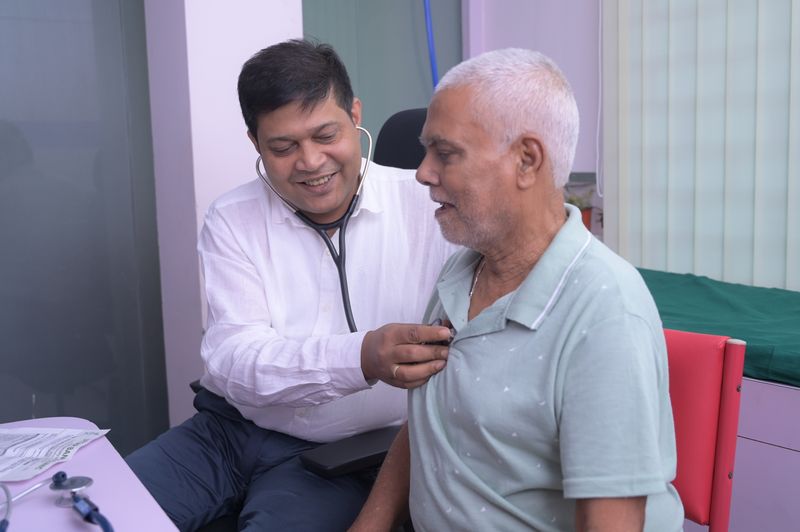
Acute fever in an adult is assessed by history, examination and staged testing rather than by an immediate antibiotic. Indian Council of Medical Research guidance is to defer both tests and antibiotics on days 1 and 2, add a full blood count and a malaria test on day 3 or 4, add paired blood cultures beyond day 5, and add chest imaging and abdominal ultrasound beyond day 7 — with one exception, that suspected malaria is tested immediately at first contact. In Cooch Behar the likely causes shift with the season: malaria, dengue and scrub typhus from the monsoon into late autumn, influenza and pneumonia in winter. Danger signs override the timetable entirely. Dr Soumya Ghosh, MD (General Medicine), assesses and treats fever at Uttarbanga Clinic, Sunity Road, Cooch Behar.
Do not wait for an appointment if any of these apply
- Confusion or drowsiness, or difficulty waking the person.
- Breathing fast — more than about 24 breaths a minute — or breathless at rest.
- Feeling worse as the fever comes down. In dengue this is the dangerous phase, usually day 3 to 7.
- New stomach pain, repeated vomiting, or bleeding from the gums, nose or in the stool.
- Passing much less urine than usual, or cold hands and feet.
- A fit, a stiff neck, or being unable to keep fluids down.
Call 108 or go directly to the emergency department at MJN Medical College & Hospital, Cooch Behar. Do not drive yourself.
For an undiagnosed fever, take paracetamol only. Not aspirin, ibuprofen or diclofenac — they worsen bleeding if the illness turns out to be dengue.
Key facts
- Patients here typically present on day 3 or 4 of the fever, usually having already taken paracetamol, a shop-bought antibiotic and something for “gas”.
- ICMR advises deferring tests and antibiotics on days 1–2 of undifferentiated fever; malaria is the exception and is tested at first contact.
- Roughly a quarter of laboratory-investigated acute undifferentiated fevers in West Bengal are scrub typhus — the pooled Indian figure is 26.4% and East India 27.5%.
- An eschar — the dark scab that textbooks call characteristic of scrub typhus — is found in only about 29% of Indian cases. Its absence excludes nothing.
- West Bengal is Plasmodium vivax-dominant (72.6% of 76,320 cases over ten years), unlike India as a whole. Rapid tests are only about 83% sensitive for vivax, so microscopy still matters.
- The national programme does not recommend dengue rapid cards, because their accuracy is unvalidated and varies batch to batch. NS1 is the test for days 1–5; IgM becomes useful from about day 5.
- Fluoroquinolones are finished for typhoid in India — pooled resistance is 82%, and one 2021–24 surveillance series found only 0.7% of isolates ciprofloxacin-susceptible.
- About a third of acute fevers in India never get a specific name even with research-grade testing — and most of those people recover anyway.
- In dengue, deterioration typically happens as the fever falls, around days 3 to 7. Feeling worse when the temperature settles is the single most important warning sign.
Most people here arrive on day three or four
Before the timetable, a fact about this practice that changes how to read it. Patients in Cooch Behar do not typically present on day one. The average is three to four days into the fever, and by then most have already taken paracetamol, an antibiotic bought over a shop counter, and something for “gas”. Many have first been seen by a rural practitioner closer to home — which for much of this district is the nearest available medical contact, and is a fact about access rather than a criticism of anyone.
Two consequences follow, and they are the reason this page is written the way it is.
First, the debate about whether to test on day one is largely theoretical here. By the time someone reaches this clinic they are usually at day three or four, which is exactly the point at which a blood count and a malaria test become informative. So the answer to “why are you testing me now when my neighbour was told to wait?” is usually that the neighbour came on day one and you came on day four.
Second, and less obviously: the antibiotic already taken changes what the tests can show, and the word “gas” can hide something dangerous. Both are dealt with below.
Why the first two days usually need no tests
This is the part patients find hardest to accept, and it is worth explaining rather than asserting. Most fevers in the first 48 hours are self-limiting viral illnesses, and testing that early produces two kinds of useless result: the tests that will eventually be positive are often not yet positive, and the tests that are positive may be measuring an old infection rather than this one. ICMR's guidance for community-onset acute undifferentiated fever in adults is explicit about day 1 and day 2 — defer investigation and antimicrobials.[1]
There is one exception, and it is absolute. Suspected malaria is tested at the first visit, on the first day, because malaria can deteriorate faster than a wait-and-see approach allows. The national malaria guidelines put it as a requirement: all clinically suspected malaria cases should be investigated immediately by microscopy and/or rapid diagnostic test.[2]
The other thing that overrides the timetable is a danger sign. Those are listed at the end of this page, and they are the part to read first if you are unwell now.
What is actually ordered, and on which day
The staged sequence below is ICMR's, and it is worth knowing that it is expert consensus rather than trial-proven — no study has established day 3 as an optimum. It is not arbitrary, though. It tracks when tests actually become informative: dengue NS1 is useful from day 1 but dengue IgM only from about day 5; blood culture yield is highest early but paired cultures only make sense once a bacterial illness is plausible; scrub typhus IgM is unreliable in the first few days.
| Day of illness | What is done |
|---|---|
| Day 1–2 | History and examination. Malaria test if suspected. Otherwise defer tests and antibiotics. |
| Day 3–4 | Full blood count with differential; malaria smear and rapid test; dengue testing where suspicion is high. |
| Beyond day 5 | The above plus paired blood cultures, and testing for dengue, chikungunya, scrub typhus and leptospirosis. |
| Beyond day 7 | The above plus chest X-ray and abdominal ultrasound. |
Two competing thresholds sit alongside this and are worth stating, because they are stricter rather than looser. Malaria, as above, is tested on day 1. And the Indian dengue guideline treats fever lasting more than three days as an indication for admission in the presence of any warning sign, not merely for testing.[3]
What changes with the season in Cooch Behar
This is where a general textbook stops being useful and local knowledge starts. The differential for a fever in this district in August is not the differential in January.
From the monsoon into late autumn — roughly June to November — the three that must be actively excluded are malaria, dengue and scrub typhus. North Bengal recorded 81 to 90 scrub typhus cases a year in the northern districts between 2018 and 2020, with deaths in each of those years, and Darjeeling has been a recognised endemic focus since 2004.[4] Dengue is endemic in the region since the 2005 Siliguri outbreak; Cooch Behar district recorded 576 cases in 2019 and neighbouring Alipurduar 2,542.[4] Japanese encephalitis also belongs on the list here in a way it does not in most of India — the northern West Bengal districts recorded 48 cases with 19 deaths in 2018, declining since.[4]
In winter the weight shifts to influenza and pneumonia. Worth knowing: India does not have the single winter influenza peak of Europe and North America. Surveillance in rural West Bengal found H1N1pdm09 circulating in the monsoon, respiratory syncytial virus in autumn, and influenza A/H3 and B in winter — two seasons, not one.[5]
Fever with jaundice is its own pattern, and here the local answer differs from the textbook one. In West Bengal, hepatitis E accounted for 41.8% of acute viral hepatitis against hepatitis A's 17.2% — so in an adult, E is the more likely of the two, and it matters most in pregnancy.[6]
Scrub typhus: the one that gets missed
If there is a single reason this page exists, it is this condition. Scrub typhus is common, treatable with an inexpensive tablet, and routinely missed — and the reason it is missed is that the textbook description is wrong for Indian patients.
A meta-analysis of 60 studies covering 34,492 acute febrile illness cases put the pooled Indian scrub typhus proportion at 26.4%, and East India at 27.5%.[7] Series from West Bengal have reported figures from 10% at North Bengal Medical College to 25.3% at Burdwan.[8] Call it roughly one in four of the fevers that get properly investigated.
Now the part that changes practice. Textbooks describe the eschar — a dark, painless, scab-covered ulcer at the site of the mite bite — as characteristic. In Indian patients it is present in only about 29% of cases: 28.5% pooled across 83 studies and 11,471 patients, with individual studies ranging from 0% to 74%.[9] In North Bengal specifically one paediatric series found 19.9%.[10] The reasons given are that eschars form in the groin, axilla, perineum and under the breast where nobody looks, that they are harder to see on darker skin, and that they heal before the patient presents. So the eschar is looked for carefully — it is diagnostic when found — but its absence excludes nothing at all.
- Eschar
- A painless ulcer with a black crust, roughly the size of a shirt button, at the site where an infected mite fed. It does not itch or hurt, which is precisely why patients do not mention it. Found in under a third of Indian scrub typhus cases.
- Acute undifferentiated febrile illness
- Fever above 38.3 °C lasting more than two days and up to fourteen, in a previously healthy adult, with no localising symptom or sign to point at an organ. It is a working label for the period before a diagnosis exists, not a diagnosis in itself.
Two further points on scrub typhus, both corrections of things widely repeated. First, mortality: the figure of 40 to 45% for untreated scrub typhus circulates constantly and comes from pre-antibiotic Japanese series. A review of 89 studies covering 19,644 patients put the median untreated case fatality at 6%.[11] Treated early, it is low single digits. Second, the dictum that failure to improve within 48 hours of doxycycline argues against the diagnosis: time to fever settling with correct treatment ranges from 12 to 96 hours, and the original data behind the 48-hour rule showed fever clearing within three days in 7 of 7 patients at one site but only 5 of 12 at another.[12] A slow response is not evidence against scrub typhus. Because delay in starting treatment is the main modifiable cause of death, ICMR explicitly permits empirical doxycycline where scrub typhus is suspected and the malaria and dengue tests are negative.[1]
Malaria here is mostly vivax, and that changes the test
India as a whole is Plasmodium falciparum-majority. West Bengal is not: across 76,320 cases over ten years, 72.6% were P. vivax and 27.3% P. falciparum.[13] That single fact has a practical consequence, because rapid diagnostic tests are much better at falciparum than vivax — a twelve-site Indian survey of 10,290 participants found sensitivity of 95% for falciparum but only 83% for vivax mono-infection.[14] A negative rapid card does not exclude vivax malaria in this district, which is why a smear is still examined rather than skipped.
Treatment differs by species too, and this is not interchangeable. Vivax needs chloroquine plus a fourteen-day course of primaquine to clear the liver stages and prevent relapse — the fourteen days are the part people stop early, and stopping early is why the fever comes back three months later. Falciparum in West Bengal is treated with artesunate plus sulfadoxine-pyrimethamine; the artemether-lumefantrine regimen is reserved for the seven north-eastern states, and West Bengal is not among them.[2] Primaquine cannot be given in pregnancy, to infants, or in G6PD deficiency.
Dengue: which test, and when
Timing decides which dengue test means anything. NS1 antigen is detectable early — around 90% sensitive on day 1, falling to 84% by day 3 — while IgM antibody is only 5% sensitive on day 1, rising to 41% by day 3 and becoming reliable from about day 5.[15] So NS1 in days 1 to 5, IgM from day 5 or 6, and in the day 4 to 6 window ideally both. IgM also persists for over 60 days, so a positive IgM alone does not prove that this fever is dengue.[3]
Something worth knowing about the test you may have had elsewhere. The national dengue guideline states plainly that the programme does not recommend the use of RDTs for diagnosis and guiding the management of dengue fever cases, because their accuracy is largely unvalidated, false positives are common, and performance varies from batch to batch.[3] The inexpensive dengue card available across the district is not a programme-endorsed test. A properly performed NS1 or IgM ELISA is.
And the treatment point that saves lives: paracetamol only. Aspirin, ibuprofen and diclofenac are avoided in suspected dengue because they add platelet inhibition and gastric injury to a condition that already lowers platelets.[3] This is consensus rather than trial-proven, but the reasoning is sound and the alternative is safe.
Typhoid: why the Widal test is not relied on
The Widal test is probably the most over-used investigation in Indian outpatient fever practice, and the problem is not that it is useless but that it is uninterpretable. Across sixteen studies its specificity ranged from 13.8% to 98%.[16] A test whose specificity might be 14% or might be 98% cannot tell you anything about an individual patient, and in a population where typhoid is endemic and many people have been vaccinated or previously exposed, a single raised titre is close to meaningless. ICMR's guidance for enteric fever does not mention Widal at all; its diagnostic pathway is blood culture.[1]
Blood culture is better but far from perfect — roughly 61% sensitive against a composite reference standard.[17] So a negative culture excludes very little.
What actually determines whether it grows is worth stating, because the received wisdom is wrong. It is widely said that Indian blood cultures are negative because the patient took an antibiotic first. For bacteraemia in general there is truth in that — a trial of 325 patients found positivity falling from 31.4% to 19.4% after a single dose.[24] But for enteric fever in India specifically, the largest dataset available — 5,703 suspected episodes in Vellore, a quarter of whom had already taken antibiotics — found no significant effect of prior antibiotics on whether the culture grew. The dominant factor was the volume of blood sent.[25] About 15 mL brings sensitivity close to bone marrow; under 3 mL reduces recovery materially, and 2 to 5 mL is what laboratories are commonly handed.[17]
So the antibiotic you took before coming is not the reason the culture may fail. Filling the bottle properly is what matters, and that is a fixable thing rather than a reason not to try.
The resistance picture has inverted in a way that surprises people trained twenty years ago. Fluoroquinolones — ciprofloxacin, ofloxacin — are effectively finished: pooled resistance in Indian Salmonella Typhi is 82%, and a 2021–2024 surveillance series across eight sites including Kolkata found only 0.7% of isolates ciprofloxacin-susceptible.[18] Meanwhile the old multidrug resistance to ampicillin, chloramphenicol and cotrimoxazole has collapsed to near zero, so those drugs have come back into use. Ceftriaxone-resistant and even carbapenem-resistant strains have now been reported from Indian centres, though they remain uncommon.[19]
Why an antibiotic is often not the answer
This is the conversation that takes the longest and matters most. ICMR states it in one sentence: no antibiotics are required for the majority of patients with acute febrile illness without an obvious clinical diagnosis.[1]
What actually happens is different. In a study of 1,000 acute febrile illness patients in rural India, 8.3% had taken an antibiotic before arriving, 31.3% received one at the outpatient visit, and acute viral illness accounted for almost half of all antibiotic use — azithromycin most often.[20] Of those who obtained further antibiotics afterwards, 73% got them from informal providers.
An antibiotic given for a viral fever does not shorten it. It does raise the chance that the next infection, in you or in someone else in Cooch Behar, does not respond — which is how ciprofloxacin stopped working for typhoid. Where there is a specific indication, an antibiotic is prescribed without hesitation and for the full course. Where there is not, the honest answer is that the fever needs a diagnosis or a few more days, and both are better than a prescription.
What happens if nothing is found
Sometimes nothing is found, and it is better to say so than to invent a label. In the best Indian multicentre study of acute fever — seven hospitals, six states, 1,564 patients, with PCR and research-grade serology — about 36% had no cause identified.[21] Of those in whom a cause was found, malaria accounted for 17%, dengue 16%, scrub typhus 10%, bacteraemia 8%, leptospirosis 7% and chikungunya 6%.
Two things follow. Most people with an unnamed fever recover regardless, which is genuinely reassuring rather than a dodge. And the same study is a caution about how multi-test fever panels are read: apparent double infections on serology panels were largely cross-reactivity and background positivity rather than genuine co-infection. A panel reporting three positives usually means one illness and two artefacts.
Fever that persists past two to three weeks is a different problem with a different list — tuberculosis, lymphoma, connective tissue disease, endocarditis, occult abscess — and it is approached separately rather than by repeating the acute panel. The formal definition of fever of unknown origin is a temperature of 38.3 °C or above for at least three weeks with no diagnosis after appropriate investigation, and even now up to half of such cases are never explained.[22]
The word “gas”, and why it is worth being careful with
“Gas” does a great deal of work in this district. It is the word patients reach for to describe almost any discomfort between the collarbones and the hips, and most of the time it means exactly what it sounds like. But it is also the word used for two things that are not gas at all, and both matter here.
The first belongs to this page. Abdominal pain is the first item on the WHO dengue warning-sign list.[23] A patient in September, four days into a fever, with new upper abdominal pain, who takes an antacid and waits, has done a reasonable-sounding thing at the single most dangerous moment of a dengue illness — because that pain is one of the signs that means hospital, and it arrives at just the point when the fever is settling and everyone has relaxed. If you have a fever and the stomach starts hurting, that is not a reason to take something for gas. It is a reason to be seen the same day.
The second is not about fever but is worth saying here because the word is the same: chest discomfort is very often described as gas or acidity, and sometimes it is neither. The reasoning behind that, and why relief from an antacid does not settle the question, is on the chest pain page.
Danger signs: when not to wait for an appointment
These override everything above. If any of them applies, go to a hospital emergency department or call 108 rather than booking a consultation.
ICMR's severity markers for adult fever are three, and they are the cleanest triggers to remember: confusion or altered consciousness, a systolic blood pressure below 90 mmHg, and a breathing rate above 24 per minute.[1] Add to those: inability to keep fluids down, repeated vomiting, a fit, neck stiffness, reduced urine output, or breathlessness at rest.
In suspected dengue, the WHO warning signs are abdominal pain or tenderness, persistent vomiting, fluid accumulation, bleeding from the gums or nose or in the stool, lethargy or restlessness, an enlarged liver, and a rising haematocrit with falling platelets.[23] But the one to hold on to is simpler and is the thing patients most often get wrong: in dengue the dangerous phase is when the fever comes down, usually somewhere between day 3 and day 7. Feeling worse as the temperature settles is not recovery going slowly. It is the warning.
সংক্ষেপে (বাংলায়)
জ্বর নিজে কোনো রোগ নয় — এটি একটি লক্ষণ, এবং কাজ হল কারণটি খুঁজে বের করা। কোচবিহারে ঋতু অনুযায়ী কারণ বদলায়: বর্ষা ও তার পরে ম্যালেরিয়া, ডেঙ্গু ও স্ক্রাব টাইফাস; শীতে ইনফ্লুয়েঞ্জা ও নিউমোনিয়া। প্রথম দুই দিনে সাধারণত পরীক্ষার দরকার হয় না — একটি ব্যতিক্রম ছাড়া, ম্যালেরিয়ার পরীক্ষা প্রথম দিনেই করা হয়। তিন-চার দিনের পরে রক্তের সিবিসি ও ম্যালেরিয়া পরীক্ষা, পাঁচ দিনের পরে রক্তের কালচার ও স্ক্রাব টাইফাসের পরীক্ষা যোগ হয়। গুরুত্বপূর্ণ কথা: পশ্চিমবঙ্গে পরীক্ষা করা প্রতি চারটি অনির্ণীত জ্বরের মধ্যে প্রায় একটি স্ক্রাব টাইফাস, এবং ভারতীয় রোগীদের মাত্র এক-তৃতীয়াংশের গায়ে সেই বৈশিষ্ট্যপূর্ণ কালো ক্ষতচিহ্ন (এসকার) পাওয়া যায় — তাই চিহ্ন না থাকা মানেই রোগ নেই, এমন নয়। ডেঙ্গুতে অ্যাসপিরিন বা আইবুপ্রোফেন নয়, শুধু প্যারাসিটামল। এবং সবচেয়ে জরুরি বিপদচিহ্ন: জ্বর কমে যাওয়ার সময়েই যদি বেশি খারাপ লাগে, দেরি করবেন না। কোচবিহারের উত্তরবঙ্গ ক্লিনিকে ডাঃ সৌম্য ঘোষ জ্বরের কারণ নির্ণয় ও চিকিৎসা করেন।

Written and medically reviewed by Dr Soumya Ghosh, MBBS, MD (General Medicine)
Consultant Physician (Internal Medicine), Uttarbanga Clinic, Cooch Behar · Assistant Professor, Dept. of General Medicine, MJN Medical College & Hospital, Cooch Behar
West Bengal Medical Council Reg. No. 67751 — verify on the Indian Medical Register · ORCID 0009-0004-1686-5540 · Last reviewed
Frequently asked questions
How many days should I wait before seeing a doctor for fever?
For an otherwise well adult, most fevers in the first 48 hours settle on their own and need no tests — ICMR guidance is to defer both investigation and antibiotics on days 1 and 2. But come sooner if malaria is possible, because that is tested on the first day rather than deferred, and come immediately regardless of the day if there is confusion, breathlessness at rest, a systolic blood pressure below 90, repeated vomiting, a fit, neck stiffness or reduced urine output.
Why won't the doctor give me an antibiotic for my fever?
Because most acute fevers are viral, and an antibiotic does not shorten a viral fever. ICMR states that no antibiotics are required for the majority of patients with acute febrile illness without an obvious clinical diagnosis. Antibiotics given without an indication are how ciprofloxacin stopped working for typhoid in India — pooled resistance is now 82%. Where there is a real indication, an antibiotic is prescribed without hesitation and for the full course.
What is scrub typhus, and why is it missed so often?
It is an infection carried by mites, common in North Bengal from the monsoon into late autumn, and it responds to inexpensive doxycycline tablets. It is missed because the textbook sign — a dark painless scab called an eschar at the bite site — is present in only about 29% of Indian cases, and because it forms in places nobody looks: the groin, armpit, perineum, under the breast. Around a quarter of properly investigated fevers in West Bengal turn out to be scrub typhus.
I don't have the black mark, so it isn't scrub typhus, is it?
That does not follow. Pooled across 83 Indian studies and 11,471 patients, an eschar was found in 28.5% of cases, with individual studies ranging from 0% to 74%. The eschar is very useful when present and means nothing when absent. The diagnosis rests on the clinical picture, the season and blood testing, not on finding a mark.
Which dengue test should I have, and when?
It depends on the day of illness. NS1 antigen is the test for days 1 to 5 — about 90% sensitive on day 1. IgM antibody is nearly useless on day 1 and becomes reliable from about day 5. In the day 4 to 6 window both are ideally done. Note also that the national dengue programme does not recommend the inexpensive rapid cards at all, because their accuracy is unvalidated and varies from batch to batch; a properly performed NS1 or IgM ELISA is the test to ask for.
Can I take ibuprofen or aspirin for a dengue fever?
No. Paracetamol only. Aspirin, ibuprofen and diclofenac add platelet inhibition and stomach injury to an illness that already lowers platelets, and the Indian national guideline advises avoiding them because they can precipitate bleeding. This applies to any fever that might be dengue, which in this district during and after the monsoon means most of them — so do not self-medicate with a painkiller from the shop.
My Widal test is positive. Do I have typhoid?
Not necessarily, and this is worth understanding. Across sixteen published studies the specificity of the Widal test ranged from 13.8% to 98% — meaning a positive result may be almost meaningless or almost conclusive depending on factors nobody can determine for an individual patient. In an endemic population where many people have prior exposure or vaccination, a single raised titre proves very little. ICMR's diagnostic pathway for enteric fever is blood culture, and Widal is not mentioned in it at all.
Why does malaria treatment here need 14 days of tablets?
Because most malaria in West Bengal is Plasmodium vivax — 72.6% of cases over a ten-year period — and vivax hides dormant stages in the liver that the initial treatment does not touch. The 14-day primaquine course clears those. Stopping it early is the commonest reason malaria returns two or three months later. It cannot be given in pregnancy, to infants, or in G6PD deficiency, which is checked first.
The rapid malaria test was negative. Is malaria ruled out?
Not in this district. Rapid tests detect falciparum malaria well — around 95% sensitivity — but vivax considerably less well, around 83% in a twelve-site Indian survey. Since West Bengal is vivax-dominant, a negative card is not enough on its own, and a blood smear is examined as well.
What if all the tests are negative and nobody can say what it is?
That is common and usually not sinister. In the best Indian multicentre study of acute fever, using PCR and research-grade serology, about 36% of 1,564 patients had no cause identified — and most people in that position recover anyway. What matters is that danger signs are excluded, that the fever is followed rather than forgotten, and that if it persists beyond two to three weeks the approach changes to a different and more thorough set of investigations.
I already took an antibiotic from the shop. Was that wrong, and does it spoil the tests?
Not wrong, and mostly it does not spoil them. For enteric fever specifically — the illness people worry about here — the largest Indian dataset, 5,703 suspected episodes in Vellore, found no significant effect of prior antibiotics on whether the blood culture grew; what mattered was the volume of blood sent to the laboratory. So bring the strips of whatever you took, say so honestly, and the testing goes ahead. The reason not to buy an antibiotic for a fever is different: it does not shorten a viral illness, and it is how ciprofloxacin stopped working for typhoid in India.
I have fever and now my stomach is hurting. Is it gas?
Possibly — but during and after the monsoon in Cooch Behar, treat that combination seriously rather than reaching for an antacid. New abdominal pain is the first item on the WHO dengue warning-sign list, and it typically appears between day 3 and day 7, exactly as the fever begins to settle. Fever plus new stomach pain means being seen the same day, not something for gas.
When is fever in dengue most dangerous?
When it falls. Deterioration in dengue characteristically happens as the temperature comes down, usually between day 3 and day 7, which is exactly when patients and families relax. Feeling worse as the fever settles — with abdominal pain, repeated vomiting, bleeding, lethargy or restlessness — needs hospital assessment the same day, not an appointment next week.
Fever assessment with Dr Soumya Ghosh
Uttarbanga Clinic, Sunity Road, near Police Line Chowpathi, Ward 20, Cooch Behar 736101. Monday to Saturday, 10:00–20:00. Walk-in or book ahead.
Related guides
References and guidelines
- Indian Council of Medical Research. Treatment Guidelines for Antimicrobial Use in Common Syndromes, 2nd edition, 2019 — chapter on management of community-onset acute undifferentiated fever in adults, and the enteric fever section. icmr.gov.in
- National Vector Borne Disease Control Programme. Guidelines for Diagnosis and Treatment of Malaria in India, 3rd edition, 2014. ncvbdc.mohfw.gov.in
- National Center for Vector Borne Diseases Control. National Guidelines for Clinical Management of Dengue Fever, 2023. ncvbdc.mohfw.gov.in
- Sharma PK, Tilak R. Outbreak-prone communicable diseases of public health importance in the northern districts of West Bengal. Indian J Med Res 2021;153(3):358–366. doi:10.4103/ijmr.IJMR_607_21
- Khan T, Halder S, Das RS, et al. Aetiology and seasonality of influenza-like illness in rural West Bengal. Front Epidemiol 2025;5:1578951. doi:10.3389/fepid.2025.1578951
- Chandra NS, Ojha D, Chatterjee S, Chattopadhyay D. Prevalence of hepatitis E virus infection in West Bengal, India. J Med Microbiol 2014;63:1319–1326. doi:10.1099/jmm.0.072249-0
- Sondhiya G, Manjunathachar HV, Singh P, Kumar R. Unveiling the burden of scrub typhus in acute febrile illness cases across India: a systematic review and meta-analysis. Indian J Med Res 2024;159(6):601–618. doi:10.25259/ijmr_1442_23
- Mallick SK, Hazra S, Nandi T, Sarkar A. Seroprevalence of scrub typhus among acute undifferentiated fever cases at a tertiary care centre in northern West Bengal. Int J Res Med Sci 2019;7(6). See also Biswas U, Bhattacharjee A, Seth S, et al. Aetiological spectrum of short-duration fever. Rev Clin Esp 2024. doi:10.1016/j.rceng.2024.06.009
- Gupta N, Kumar TP, Boodman C, et al. Prevalence of eschar in scrub typhus in India: a systematic review and meta-analysis. Le Infezioni in Medicina 2024;32(3):312–322. doi:10.53854/liim-3203-5
- Jana JK, et al. Clinical profile and outcome of paediatric scrub typhus in Bankura, West Bengal. Cureus 2023;15(8):e41976. doi:10.7759/cureus.41976
- Taylor AJ, Paris DH, Newton PN. A systematic review of mortality from untreated scrub typhus. PLoS Negl Trop Dis 2015;9(8):e0003971. doi:10.1371/journal.pntd.0003971
- Wangrangsimakul T, Phuklia W, Newton PN, Richards AL, Day NPJ. Scrub typhus and the misconception of doxycycline resistance. Clin Infect Dis 2020;70(11):2444–2449. doi:10.1093/cid/ciz972. See also Gupta N, Boodman C, et al. BMC Infect Dis 2023;23:884.
- Maiti M, Roy U. Spatiotemporal distribution of malaria in West Bengal, India, 2011–2021. Malar J 2024;23:145. doi:10.1186/s12936-024-05015-9
- Dahal P, Singh-Phulgenda S, Nema S, et al. Diagnostic performance of malaria rapid diagnostic tests across India. Malar J 2025. doi:10.1186/s12936-025-05556-7
- Hunsperger EA, Muñoz-Jordán J, Beltran M, et al. Performance of dengue diagnostic tests by day of illness. J Infect Dis 2016;214(6):836–844. doi:10.1093/infdis/jiw103
- Mengist HM, Tilahun K. Diagnostic value of the Widal test in the diagnosis of typhoid fever: a systematic review. J Med Microbiol Diagn 2017;6(3):248. doi:10.4172/2161-0703.1000248
- Mogasale V, Ramani E, Mogasale VV, Park J. What proportion of Salmonella Typhi cases are detected by blood culture? A systematic literature review. Ann Clin Microbiol Antimicrob 2016;15:32. doi:10.1186/s12941-016-0147-z
- Mogasale VV, Zhang P, John J, et al. Antimicrobial resistance in Salmonella Typhi in India, 1977–2024: a systematic review and meta-analysis. PLoS Negl Trop Dis 2026. doi:10.1371/journal.pntd.0014206. Surveillance corroboration: Sahai et al. Sci Rep 2025;15. doi:10.1038/s41598-025-93170-7
- Sah R, Donovan S, Seth-Smith HMB, et al. A novel lineage of ceftriaxone-resistant Salmonella Typhi from India. Clin Infect Dis 2020;71(5):1327. doi:10.1093/cid/ciz1204. See also Thirumoorthy TP, et al. Carbapenem-resistant Salmonella Typhi. Front Microbiol 2025;16.
- Holloway B, et al. Antibiotic use in acute febrile illness in rural India. Antibiotics 2022;11(5):574. doi:10.3390/antibiotics11050574
- Mørch K, Manoharan A, Chandy S, et al. Acute undifferentiated fever in India: a multicentre study of aetiology and diagnostic accuracy. BMC Infect Dis 2017;17:665. doi:10.1186/s12879-017-2764-3
- Haidar G, Singh N. Fever of unknown origin. N Engl J Med 2022;386:463–477. doi:10.1056/NEJMra2111003
- World Health Organization. Dengue: Guidelines for Diagnosis, Treatment, Prevention and Control, 2009. who.int
- Cheng MP, Stenstrom R, Paquette K, et al. Blood culture results before and after antimicrobial administration in patients with severe manifestations of sepsis (FABLED). Ann Intern Med 2019;171(8). doi:10.7326/M19-1696
- Srinivasan M, et al. Factors affecting blood culture yield in the diagnosis of enteric fever in India. J Infect Dis 2021;224(Suppl 5):S484–S493. doi:10.1093/infdis/jiab357
This page is general health information written and reviewed by a registered medical practitioner. It is not medical advice, does not create a doctor–patient relationship, and is not a substitute for consultation with a doctor who has examined you. Diagnosis and treatment are individualised after clinical assessment. Medicines mentioned here are prescription-only and must be taken under medical supervision. See the editorial and medical review policy. Last reviewed .