Swelling of the legs — one leg, or both?
That single question splits the diagnosis in half before any test is done. One leg points at something in the leg. Both legs point at the heart, the kidneys, the liver, the blood — or, very often, at a tablet.
পা ফোলা — এক পা না দু'পা, সেই প্রশ্নেই অর্ধেক রোগনির্ণয় হয়ে যায়। কারণ, পরীক্ষা ও কখন দেরি করা চলবে না।
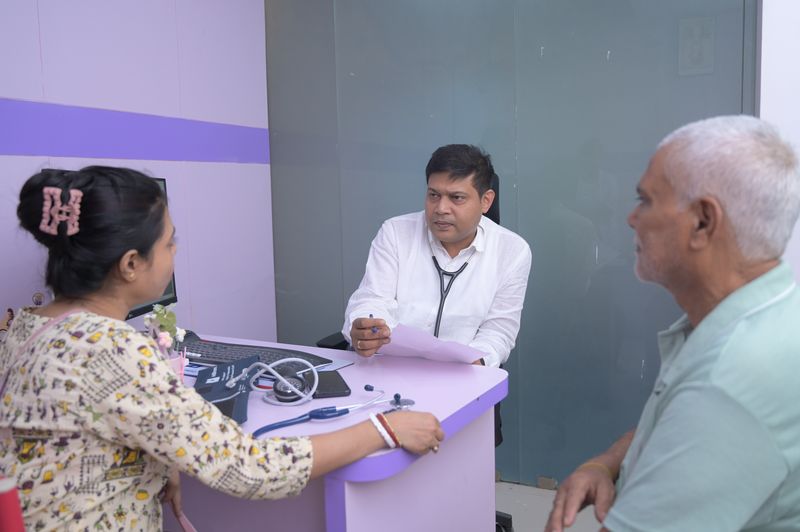
Swelling of the legs divides at the first question: one leg or both. Unilateral swelling suggests a local cause in that leg — deep vein thrombosis, cellulitis, chronic venous disease or lymphoedema. Bilateral swelling suggests a systemic cause — heart failure, kidney disease, liver disease, low blood protein — or a drug. The drug matters more than most people expect: calcium channel blockers such as amlodipine, the commonest blood pressure tablet in India, cause ankle swelling in 10.7% of users overall, 16.1% at higher doses, and up to 23.8% after six months or more. Sudden swelling of one leg with pain or breathlessness needs assessment the same day. Dr Soumya Ghosh, MD (General Medicine), assesses leg swelling at Uttarbanga Clinic, Sunity Road, Cooch Behar.
Do not wait for an appointment if any of these apply
- One leg suddenly swollen, painful or warm — especially with breathlessness or chest pain
- Swelling with fever and a spreading red, hot, tender area
- Swelling with breathlessness at rest or when lying flat
- Swelling that has appeared over days along with a marked fall in the amount of urine passed
- Swelling of the face and around the eyes, especially in the morning, along with frothy urine
- Swelling with yellow eyes or a swollen abdomen
Call 108 or go directly to the emergency department at MJN Medical College & Hospital, Cooch Behar. Do not drive yourself.
A suddenly swollen, painful calf can be a clot, and a clot that travels to the lung is what kills. Breathlessness with a swollen leg is an emergency, not an appointment.
Key facts
- The first question is one leg or both. It splits the differential before any test.
- Amlodipine and related drugs cause ankle swelling in 10.7% of users against 3.2% on control — 5.7% at low dose, 16.1% at high dose, and rising from 2.3% at four weeks to 23.8% at six months or more.
- Adding an ACE inhibitor reduces calcium-channel-blocker swelling, which is often a better answer than stopping a blood pressure tablet that is working.
- Up to 75% of legs that look clinically like deep vein thrombosis turn out to be something else.
- In the Indian CKD registry, 48% of patients were already in Stage V at first presentation — swelling is often the first symptom of kidney disease anyone notices.
The question that splits the diagnosis
Before anything else: is it one leg or both? The distinction is not a formality, and it does more diagnostic work than most blood tests. Bilateral or generalised swelling points to a systemic cause — heart failure, kidney disease, liver disease, low blood protein, obstructive sleep apnoea, or a drug. Unilateral swelling points to something in that leg — deep vein thrombosis, chronic venous insufficiency, lymphoedema, cellulitis, or a mass obstructing the vein.[1]
The second question is how quickly it appeared. Swelling of one leg that came on over hours to a couple of days needs assessment for a clot the same day. Swelling that has crept up over months is a different investigation and a different urgency.
The third question — and this is the one most often skipped — is what tablets you are taking.
The tablet that causes it in one in ten people
Amlodipine is probably the most widely prescribed blood pressure tablet in India, and ankle swelling is its commonest side effect. The numbers are precise, because a meta-analysis of 106 studies and 99,469 participants measured them: peripheral oedema in 10.7% (95% CI 10.6–10.9) on calcium channel blockers against 3.2% (3.1–3.3) on control.[2]
Three features of that finding are what make it clinically useful:
| Factor | Lower | Higher |
|---|---|---|
| Dose | 5.7% at low dose | 16.1% at high dose |
| Duration | 2.3% at four weeks | 23.8% at 26 weeks or more |
| Drug class | 3.1% with non-dihydropyridines | 12.3% with dihydropyridines such as amlodipine |
The duration figure is the one that defeats the diagnosis in practice. Someone started on amlodipine in January whose ankles swell in August does not connect the two, because the tablet has been "fine" for months. Nearly one in four long-term users is affected.[2]
Two practical points follow. First, do not stop a blood pressure tablet on your own — bring the strip to the consultation. Second, stopping it is often not the answer anyway: adding an ACE inhibitor reduces calcium-channel-blocker oedema,[1] and switching within the class is another option, so a tablet that is controlling your blood pressure well does not have to be abandoned.
Both legs: the systemic causes
The heart
Bilateral swelling that is worse in the evening, better after a night lying down, and comes with breathlessness — particularly breathlessness lying flat or waking you at night — is heart failure until shown otherwise. The Indian context matters: in the National Heart Failure Registry of 10,850 patients, the mean age at presentation was 59.9 years, about a decade younger than in high-income countries, with ischaemic disease in 71.9% and rheumatic heart disease in 5.4%; one-year mortality was 22.1%.[3] Echocardiography is what settles it and is referred.
The kidneys
Kidney disease produces swelling in two different ways, and they need separating. Chronic kidney disease causes fluid retention as filtration falls. Nephrotic syndrome causes swelling by losing protein into the urine, and it characteristically produces puffiness around the eyes in the morning as well as leg swelling, often with frothy urine.
Chronic kidney disease affects around 17.2% of Indian adults in the SEEK-India study, with eGFR below 60 in 5.9%, and anaemia in 40.7% of those with CKD.[4] The more sobering figure comes from the Indian CKD Registry of 52,273 patients across more than 200 centres: 48% presented already in Stage V, with diabetic nephropathy the commonest cause at 31%.[5] Kidney disease is quiet until late, and swelling is often the first thing that brings someone in.
In eastern India, nephrotic syndrome is the commonest reason for a kidney biopsy — 63.6% of 1,312 native kidney biopsies in a Patna series — with focal segmental glomerulosclerosis the leading pattern at 23%.[6] Urine albumin, creatinine and eGFR are the first tests, and they are inexpensive.
The liver, and low blood protein
Cirrhosis causes leg swelling together with abdominal distension. In West Bengal, alcohol-use disorder affects about 3.04% of adults, with a treatment gap of 89.2% — and notably a female-to-male ratio of 1:5 in West Bengal against 1:18 nationally.[7] A Kolkata series of 395 patients with alcohol-related liver disease found that 79.7% already had cirrhosis or acute-on-chronic liver failure at presentation.[8]
Low blood protein from malnutrition or protein loss also causes swelling, and it is worth remembering alongside anaemia in a state where 71.4% of women and 38.9% of men aged 15–49 are anaemic.[9]
One leg: the local causes
Sudden unilateral swelling with pain and warmth is deep vein thrombosis until excluded, and the exclusion is a duplex ultrasound rather than an examination. It is worth knowing that clinical suspicion is a poor test on its own: up to 75% of legs that look like DVT turn out to be something else — a ruptured Baker's cyst, a calf muscle tear, cellulitis, a popliteal aneurysm, or a soft-tissue mass.[10] That cuts both ways. It means most suspected clots are not clots; it also means the diagnosis cannot be made or dismissed by looking.
Cellulitis — a spreading, hot, red, tender area with fever — is a clinical diagnosis and needs antibiotics promptly. Chronic venous insufficiency produces gradual swelling with skin changes and varicose veins, worse at the end of the day.
Lymphatic filariasis
This needs stating carefully, because the temptation is to overstate a locally resonant diagnosis. Lymphatic filariasis is endemic in West Bengal — official figures record 12 endemic districts in the state, with 110,629 clinically manifested cases recorded in 2013 and mass drug administration coverage of 86.77% that year.[11] Nationally, 348 districts across 20 states and union territories are endemic, 143 of them have stopped mass drug administration after clearing transmission assessment surveys, and the elimination target is 2027.[12]
Whether Cooch Behar itself is currently on the endemic list could not be established from a definitive source. One peer-reviewed paper covering the sub-Himalayan districts names Cooch Behar among the endemic districts; another published list of West Bengal endemic districts omits it. The official programme page publishes its district list only as an image. Rather than assert either version, this page states the uncertainty, and the position at the clinic is that the diagnosis is considered on the clinical picture and a night blood film where the history fits, not on a district list.
Two further facts are relevant. Mass drug administration was suspended in March 2020 and did not resume until February 2024, so transmission was not interrupted through that period.[13] And filarial lymphoedema is not always accompanied by detectable microfilariae — in a survey across four West Bengal districts, 2.13% had chronic lymphoedema while being microfilaria-negative.[13] That survey was conducted in high-burden coalfield communities using non-probabilistic sampling and its prevalence figures are an upper bound for those districts, not a figure for Cooch Behar.
What matters clinically: filarial lymphoedema is usually unilateral or asymmetric, does not pit deeply once established, involves the foot and toes, and is progressive. It is a different examination finding from the soft pitting swelling of heart failure or amlodipine, and it is treated differently.
What is done at the consultation
One leg or both. How fast it came on. Whether it pits. Whether the face is puffy in the morning. What the urine looks like. What tablets you are on — bring the strips. Then an ECG, blood count, creatinine and eGFR, urine albumin, liver function and albumin, and thyroid function. Echocardiography and duplex ultrasound are arranged where indicated; there is no ultrasound machine at the clinic. Reports are reviewed with you at follow-up, which is not charged within 10 days.
সংক্ষেপে (বাংলায়)
পা ফোলা দেখলে প্রথম প্রশ্ন — এক পা না দু'পা? এক পা ফুললে কারণ সাধারণত ওই পায়েই (শিরায় রক্ত জমাট, সংক্রমণ, ফাইলেরিয়া)। দু'পা ফুললে কারণ শরীরের ভিতরে — হার্ট, কিডনি, লিভার, বা রক্তে প্রোটিন কম। আর একটি কারণ প্রায়ই বাদ পড়ে যায়: রক্তচাপের ওষুধ অ্যামলোডিপিন। যাঁরা এটি খান তাঁদের ১০.৭%-এর পা ফোলে, বেশি ডোজে ১৬.১%, আর ছ'মাসের বেশি খেলে ২৩.৮% পর্যন্ত। ওষুধ নিজে থেকে বন্ধ করবেন না — পাতাটা নিয়ে আসুন, বদলে দেওয়া যায়। হঠাৎ এক পা ফুলে গিয়ে ব্যথা ও শ্বাসকষ্ট হলে দেরি করবেন না।

Written and medically reviewed by Dr Soumya Ghosh, MBBS, MD (General Medicine)
Consultant Physician (Internal Medicine), Uttarbanga Clinic, Cooch Behar · Assistant Professor, Dept. of General Medicine, MJN Medical College & Hospital, Cooch Behar
West Bengal Medical Council Reg. No. 67751 — verify on the Indian Medical Register · ORCID 0009-0004-1686-5540 · Last reviewed
Frequently asked questions
My ankles swell and I take amlodipine. Are they related?
Very possibly. Calcium channel blockers such as amlodipine cause ankle swelling in about one in ten users overall, one in six at higher doses, and nearly one in four after six months or more of treatment. The delay is why people do not connect the two. Do not stop the tablet yourself — bring the strip. Often the answer is not stopping it but adding an ACE inhibitor, which reduces the swelling, or switching within the class.
Is one swollen leg more serious than two?
It is more urgent, though not necessarily more serious in the long run. One suddenly swollen, painful leg raises the possibility of a clot in a deep vein, and a clot that travels to the lung is life-threatening. That needs assessment the same day, particularly with any breathlessness or chest pain. Two swollen legs usually indicates a systemic cause — heart, kidneys, liver or a drug — which needs proper investigation but not usually the same hour.
Can leg swelling be a kidney problem even if I feel well?
Yes, and that is exactly the pattern. Kidney disease is quiet until it is advanced — in the Indian CKD registry, 48% of patients were already in Stage V at first presentation. Swelling, particularly puffiness around the eyes in the morning with frothy urine, may be the first thing anyone notices. Creatinine, eGFR and urine albumin are cheap tests and are done early.
Could this be filaria?
It is considered where the clinical picture fits. Filarial lymphoedema is typically asymmetric, involves the foot and toes, becomes firm rather than deeply pitting over time, and progresses. Lymphatic filariasis is endemic in West Bengal, though whether Cooch Behar district is currently on the endemic list is not something that can be established from a reliable published source. The diagnosis is made on the picture and a night blood film where indicated, not on a district list.
The swelling goes down overnight and comes back by evening. What does that mean?
That pattern — better after lying flat all night, worse by the end of a day on your feet — is typical of fluid that redistributes with gravity, which fits heart failure, venous disease and drug-related oedema. It does not by itself distinguish between them, so it is a useful description to give but not a diagnosis. Swelling that does not improve overnight at all suggests lymphatic obstruction instead.
Assessment of leg swelling with Dr Soumya Ghosh
Uttarbanga Clinic, Sunity Road, near Police Line Chowpathi, Ward 20, Cooch Behar 736101. Monday to Saturday, 10:00–20:00. Walk-in or book ahead.
References and guidelines
- Trayes KP, Studdiford JS, Pickle S, Tully AS. Edema: diagnosis and management. Am Fam Physician 2013;88(2):102–110. aafp.org
- Makani H, Bangalore S, Romero J, et al. Peripheral oedema associated with calcium channel blockers: incidence and withdrawal rate — a meta-analysis of randomized trials. J Hypertens 2011;29(7):1270–1280. ncbi.nlm.nih.gov
- Harikrishnan S, et al. The National Heart Failure Registry of India. Nat Commun 2025. doi:10.1038/s41467-024-55362-z
- Singh AK, et al. Epidemiology and risk factors of chronic kidney disease in India — results from the SEEK study. BMC Nephrol 2013;14:114. doi:10.1186/1471-2369-14-114
- Rajapurkar MM, et al. What do we know about chronic kidney disease in India: first report of the Indian CKD registry. BMC Nephrol 2012;13:10. doi:10.1186/1471-2369-13-10
- Krishna A, et al. Histopathological spectrum of native kidney biopsy from eastern India: a single-centre observational study. Turk J Nephrol 2023;32. doi:10.5152/turkjnephrol.2023.22365
- Basu A, et al. Prevalence and treatment gap of substance use disorders in West Bengal: findings from the National Mental Health Survey. Indian J Psychol Med 2024;46(6):558–563. doi:10.1177/02537176241265079
- Ray G, Manjubhargav P. Clinical spectrum and outcome of alcohol-related liver disease in eastern India. Inflamm Intest Dis 2019;4(3). doi:10.1159/000501274
- International Institute for Population Sciences & Ministry of Health and Family Welfare. NFHS-5, 2019–21: West Bengal. Anaemia figures corroborated in MoHFW, Anaemia Mukt Bharat, 4 February 2022. pib.gov.in
- Paramesparan K, Iqbal A, Shah A, Botchu R. Imaging of the unilateral swollen painful lower leg: deep vein thrombosis mimics. Indian J Musculoskelet Radiol 2019. doi:10.25259/IJMSR_15_2019
- Ministry of Health & Family Welfare, Government of India. Press release on lymphatic filariasis in West Bengal, 21 February 2014. pib.gov.in; and NVBDCP Annual Report 2014–15. ncvbdc.mohfw.gov.in
- Ministry of Health & Family Welfare. National status of the lymphatic filariasis elimination programme, 10 February 2026. pib.gov.in
- Chakraborty P, Sadhu A, Modak BK, et al. Community survey of lymphatic filariasis in endemic districts of West Bengal. Sci Rep 2026. doi:10.1038/s41598-026-43973-z. Non-probabilistic sampling in high-burden communities; prevalence figures are an upper bound for those districts and are not a Cooch Behar figure.
This page is general health information written and reviewed by a registered medical practitioner. It is not medical advice, does not create a doctor–patient relationship, and is not a substitute for consultation with a doctor who has examined you. Diagnosis and treatment are individualised after clinical assessment. Medicines mentioned here are prescription-only and must be taken under medical supervision. See the editorial and medical review policy. Last reviewed .