Chest pain: gas, or the heart?
Most chest pain is not cardiac. The difficulty is that the pain which is cardiac is very often described as gas or acidity — and in this district that costs hours, at the one point in a heart attack where hours matter most.
বেশিরভাগ বুকে ব্যথা হার্টের নয়। সমস্যা হল, যেটি হার্টের, সেটিকেও অনেকে ‘গ্যাস’ বলে ধরে নেন — এবং তাতে সবচেয়ে দামি কয়েক ঘণ্টা নষ্ট হয়।
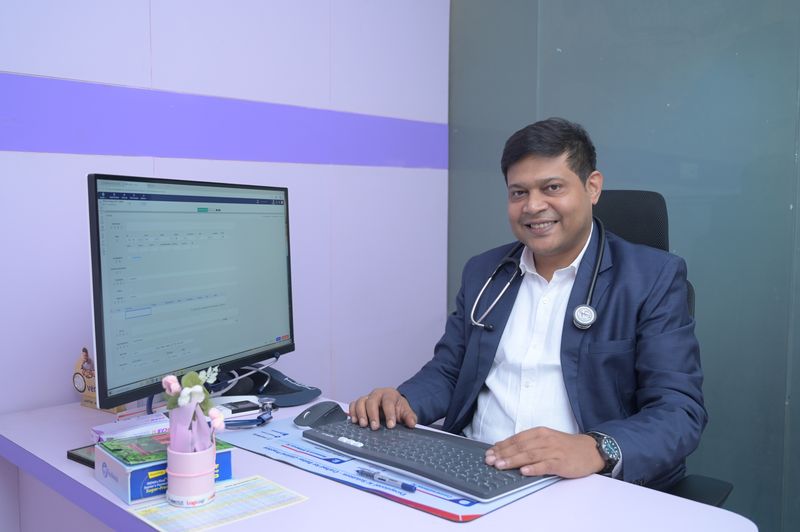
Chest pain is assessed by working out how likely a cardiac cause is, and excluding that first, before considering the far commoner non-cardiac causes. In primary care only about 2 to 4% of chest pain turns out to be a heart attack or unstable angina, but the consequence of missing those is severe, so the order of assessment is fixed: history, examination, ECG, and cardiac markers where indicated. Two things patients rely on do not work — relief from an antacid does not exclude cardiac pain, and a normal first ECG does not either. Crushing chest pain with sweating, nausea or breathlessness is an emergency: call 108 and go to hospital rather than to a clinic. For a stable patient presenting after symptoms have settled, an ECG is done during the consultation and troponin T on a one-hour protocol is available locally through the Apollo laboratory. Dr Soumya Ghosh, MD (General Medicine), assesses chest pain at Uttarbanga Clinic, Sunity Road, Cooch Behar.
Do not wait for an appointment if any of these apply
- Crushing or pressing chest pain, especially spreading to the left arm, both arms, the jaw or the back.
- Chest pain with sweating, nausea or breathlessness.
- Chest pain that comes on with exertion and eases with rest, appearing for the first time.
- Chest pain with fainting, or a very fast or irregular pulse.
- Sudden severe breathlessness with chest pain.
- Any chest discomfort if you have diabetes — a third of heart attacks cause little or no pain, and diabetes is one of the reasons why.
Call 108 or go directly to the emergency department at MJN Medical College & Hospital, Cooch Behar. Do not drive yourself.
Note the time your symptoms started. It is the first thing the hospital will ask, and the answer decides which treatments are still available.
Key facts
- In primary care only about 1.5 to 3.6% of people presenting with chest pain turn out to have an acute coronary syndrome — but that small fraction is the whole reason for the order of assessment.
- Indian patients reach hospital a median of roughly five to six hours after symptoms begin, several times longer than in high-income countries. The commonest reason recorded is not distance — it is not recognising the symptoms.
- About a third of heart attacks present without chest pain at all (33% of 434,877 patients) — more often in women, older people and those with diabetes.
- Relief from an antacid does not exclude cardiac pain. Even relief from nitroglycerin, the drug that should be specific, does not: 35% of patients with coronary disease improved with it versus 41% without.
- A normal first ECG does not exclude a heart attack. In 1,675 patients with suspected heart attack, 78.9% had no ischaemic change on either the admission ECG or the one three hours later.
- Pain reproducible by pressing on the chest wall makes a cardiac cause much less likely (likelihood ratio about 0.25) but does not exclude it — 6% of patients labelled costochondritis in one series were having a heart attack.
- Panic and anxiety account for 18 to 26% of chest pain in emergency departments, and are correctly identified in only about 15% of family-practice cases.
- Troponin T on a one-hour protocol is available locally through the Apollo laboratory, which makes a proper rule-out possible in Cooch Behar rather than only at a hospital — with one important limit on when that is the right thing to do, set out below.
Why chest pain gets called gas here
This is the observation that made me write the page, and I want to be straightforward about its status. In this practice, chest discomfort is very frequently presented as “gas” or acidity. Patients arrive having taken an antacid, sometimes for days, and describe the problem in gastric terms even when the story sounds cardiac. That is a clinical observation from a Cooch Behar outpatient practice, not published epidemiology.
What is published is the consequence. Indian patients with a heart attack reach hospital a median of roughly five to six hours after symptoms begin — documented across 20,937 admissions in 89 centres in the CREATE registry, and described there as several times longer than in high-income countries.[1] A 2022 study from north-east India, the nearest comparable geography, found a mean of 355 minutes, with only 54% of patients arriving inside the window where treatment works best; the principal cause the authors identified was patients not recognising their symptoms at onset.[2]
On the specific question of what people mistake it for, there is a genuine gap in the Indian literature — I could not find an Indian study quantifying misattribution of cardiac pain to gas or acidity. The nearest quantified evidence is from Karachi: of 300 patients with acute myocardial infarction, 36.3% had interpreted their symptoms as non-cardiac, and of those, 57.5% had attributed them to “gastric” problems — and misinterpretation significantly predicted delay, with over half of that group arriving beyond six hours.[3] Internationally, a systematic review of 25 studies and 14,843 patients found that only 45.1% of people having an acute coronary syndrome correctly attributed their symptoms to the heart.[4]
So roughly half of everyone, everywhere, gets this wrong. That is worth knowing, because it means the mistake is not ignorance. It is what the sensation actually feels like.
First, the reassuring part: most chest pain is not the heart
In general-practice populations, only about 1.5 to 3.6% of people presenting with chest pain are diagnosed with an acute coronary syndrome, across a systematic review of 14 studies.[5] Widen it to coronary heart disease of any kind and a study of 1,199 primary-care chest pain patients found 14.9%.[6] The commoner causes, by a distance, are chest wall and musculoskeletal pain, reflux, anxiety, and pain from the cervical spine.
Those figures are European and North American. I could not find an Indian primary-care study of what chest pain turns out to be, so treat the proportions as indicative rather than local.
The logic of assessment follows from the arithmetic, though. When something is uncommon but dangerous and the alternatives are common but benign, you exclude the dangerous one first — not because it is likely, but because it is the only one where being wrong for two hours matters. That is why an ECG gets done for a pain that will probably turn out to be muscular.
Why an antacid making it better proves nothing
This is the single most important idea on the page, and it runs directly against intuition.
If a pain settles after an antacid, it feels like proof the pain came from the stomach. It is not. The evidence here is cleanest for nitroglycerin — the drug that ought to be specific to cardiac pain, because it works by dilating coronary arteries. In 459 patients presenting to an emergency department, nitroglycerin relieved chest pain in 35% of those with active coronary disease and 41% of those without, a difference that was not statistically significant.[7] If the drug that targets the coronary arteries cannot tell you whether the problem is the coronary arteries, an antacid certainly cannot.
The “GI cocktail” — antacid given to see whether the pain settles — has never been shown to distinguish the two, and the major review of chest pain history features does not list antacid response among the findings with usable diagnostic value at all.[8] That absence is the point: it is not that the test performs poorly, it is that it has never been shown to perform.
There is also a simple reason why relief is unreliable. Cardiac pain waxes and wanes on its own. Anything taken during a waning phase looks like it worked.
What actually shifts the probability
Individual features do carry real information, and it is worth knowing which. The figures below are likelihood ratios — how much a finding multiplies or divides the odds of a heart attack. A ratio above 1 raises the probability, below 1 lowers it.
| Feature | Likelihood ratio | Direction |
|---|---|---|
| Radiates to right arm or shoulder | 4.7 | Raises |
| Radiates to both arms | 4.1 | Raises |
| Brought on by exertion | 2.4 | Raises |
| Radiates to left arm | 2.3 | Raises |
| With sweating | 2.0 | Raises |
| With nausea or vomiting | 1.9 | Raises |
| Sharp in character | 0.3 | Lowers |
| Worse on breathing in | 0.2 | Lowers |
| Changes with position | 0.3 | Lowers |
| Reproduced by pressing the chest wall | 0.3 | Lowers |
Two things to notice. Nothing in that table is anywhere near zero — not one feature excludes a heart attack on its own. And the strongest single predictor is not in the table at all: it is whether the person already has known vascular disease, which in a primary-care study carried a likelihood ratio of 4.51.[6]
The chest-wall point deserves its own sentence, because it is the one most often over-read. Pain reproducible by pressing does make a cardiac cause considerably less likely. It does not exclude it: in one series, 6% of emergency department patients labelled with costochondritis were in fact having a heart attack.[9]
Why a normal ECG does not settle it either
An ECG is done in the consultation because it is fast, free of risk and occasionally decisive. What it is not is a rule-out test.
The numbers are stark. Standard ECG criteria for a STEMI — the kind of heart attack caused by a completely blocked artery — have a pooled sensitivity of about 63.5% for occlusive infarction across 9 studies and 11,757 patients, meaning roughly a third of people needing urgent intervention do not meet them.[10] And among 1,675 patients presenting with suspected heart attack, 78.9% had no ischaemic changes on either the admission ECG or a repeat three hours later.[11]
So an ECG that looks normal narrows nothing very much. What it does is catch the cases where it is abnormal — and in those, catching it in the first hour rather than the sixth is the difference the whole delay literature is about.
- Troponin
- A protein released when heart muscle is damaged. Modern practice uses high-sensitivity assays on a defined timetable rather than as a single reading — the European guideline's first-choice algorithm compares a level taken on arrival with one taken an hour later, because a single value early in an infarction can still be normal and it is the change that carries the information. That comparison needs a quantitative laboratory assay reported as a number, not a card that reads positive or negative.
- Acute coronary syndrome
- The group of conditions caused by a sudden reduction in blood supply to heart muscle: unstable angina and the two kinds of heart attack. The term covers a spectrum rather than a single diagnosis, which is why assessment is about probability rather than a yes or no.
What can actually be done in Cooch Behar
Being plain about this, because it has changed and because most people assume otherwise.
An ECG is done here, during the consultation. And troponin T on a one-hour protocol is available locally through the Apollo laboratory — a quantitative result, reported as a number, with a second sample an hour after the first. That matters more than it sounds. India's National Essential Diagnostics List places troponin at district-hospital level rather than clinic level,[12] and much of what is available at clinic level across the country is a qualitative card that reads positive or negative — which cannot support the one-hour comparison at all, because there is no number to compare. Having the quantitative assay within reach means a proper rule-out is possible in this district rather than only after a journey.
And here is the limit, which is the important half. The one-hour algorithm was designed for a patient who stays under observation between the two samples, in a place with a defibrillator and staff. It is not designed for someone who goes home for an hour and comes back. So the way it is used here is specific: it is for the patient who presents stable, some hours after symptoms that have settled, where the question is whether anything happened at all. That patient can be worked up locally.
The patient with ongoing chest pain, or an abnormal ECG, or who looks unwell, does not wait in a clinic for a laboratory result. They go to hospital, and getting them there fast is the single most useful thing this consultation does. A troponin result an hour from now is no use to someone who needs an artery opened in the next ninety minutes.
When a heart attack does not hurt much
This is the part that most changes what you should do, and it applies particularly to people who read this site.
Across 434,877 patients in a national registry, 33% of heart attacks presented without chest pain at all, and their in-hospital mortality was 23.3% against 9.3% for those with pain.[13] A later analysis of over 1.1 million patients put the figure at 35.4% overall, with 42.0% of women and 30.7% of men presenting without chest pain — and the sex difference was widest in younger patients.[14] People with diabetes were substantially over-represented in the no-pain group.
What it looks like instead: breathlessness, sudden profound fatigue, sweating, nausea, a vague sense of something being badly wrong. If you have diabetes — and a large share of the people this clinic sees do — the absence of severe pain is not reassurance. It is a known feature of the disease you already have.
Worth noting that current guidance has abandoned the word “atypical” for these presentations, precisely because calling them atypical made clinicians treat them as unlikely. The 2021 American guideline recommends describing pain as cardiac, possibly cardiac or non-cardiac instead.[15] They are not atypical. They are one third of all heart attacks.
What it usually is instead
Having spent this page on the cardiac question, the honest resolution is that most of the time the answer is one of these.
Chest wall and musculoskeletal pain is the commonest, including costochondritis at roughly 13% of primary-care chest pain. It is tender to press, worse on certain movements, and settles with time and simple analgesia.
Reflux and acid-related pain is genuinely common, and often genuinely is what the patient thought. It typically worsens after meals and on lying flat, and a trial of a proton pump inhibitor that clearly helps carries a likelihood ratio of about 5.5 for reflux disease.[16] The distinction from cardiac pain is made by the whole picture, not by whether an antacid helped once.
Anxiety and panic account for 18 to 26% of chest pain in emergency departments and about 25% in family practice — and are badly under-recognised, correctly identified in only around 15% of family-practice cases in one review.[17] This is a real diagnosis with effective treatment, not a way of saying nothing is wrong, and it is worth asking about directly.
Pulmonary embolism deserves naming because it is missed. In 1,000 consecutive adult medical autopsies at an Indian tertiary centre, pulmonary embolism was present in 15.9% and clinically significant in 12.6% — and 79.9% of those cases were in people under 50.[18] That is an autopsy series and so biased towards severity, but it is a reasonable warning against assuming that a young patient with sudden breathlessness and chest pain has anxiety.
Also on the list: pleurisy, shingles before the rash appears, and pain referred from the cervical spine.
Danger signs: call 108, do not book an appointment
If any of the following applies, the correct destination is a hospital emergency department, not this clinic.
Crushing or pressing central chest pain, particularly if it spreads to the left arm, both arms, the jaw or the back, and especially with sweating, nausea or breathlessness. Pain that comes on with exertion and settles with rest, appearing for the first time. Chest pain with fainting, or with a very fast or very irregular pulse. Sudden severe breathlessness with chest pain. Any of these in someone with diabetes, even if the pain is mild — see the section above.
Two practical points that matter more than they sound. Do not drive yourself, and do not be driven by a relative who is panicking; call 108. And note the time the symptoms started, because it is the first question the hospital will ask and the answer determines which treatments are still available.
The nearest emergency department is at MJN Medical College & Hospital, Cooch Behar.
সংক্ষেপে (বাংলায়)
বুকে ব্যথা মানেই হার্টের সমস্যা নয় — প্রাথমিক চিকিৎসায় আসা বুকে ব্যথার মাত্র ২ থেকে ৪ শতাংশ হার্ট অ্যাটাক বা অস্থির অ্যানজাইনা। কিন্তু সমস্যা উল্টো দিকে: এই অঞ্চলে হার্টের ব্যথাকে বহু রোগী ‘গ্যাস’ বা ‘অ্যাসিডিটি’ বলে ধরে নেন, অ্যান্টাসিড খেয়ে অপেক্ষা করেন, এবং হাসপাতালে পৌঁছতে ভারতে গড়ে পাঁচ-ছয় ঘণ্টা লেগে যায় — যেখানে চিকিৎসার সবচেয়ে কার্যকর সময় প্রথম কয়েক ঘণ্টা। মনে রাখার মতো দুটি কথা: অ্যান্টাসিড খেয়ে ব্যথা কমে গেলেও হার্টের সমস্যা বাদ যায় না, এবং প্রথম ইসিজি স্বাভাবিক এলেও হার্ট অ্যাটাক বাদ যায় না। ডায়াবেটিস থাকলে ব্যথা আশ্চর্যরকম কম হতে পারে। ভালো খবর — কুচবিহারেই অ্যাপোলো ল্যাবে এক ঘণ্টার ট্রোপোনিন টি পরীক্ষা পাওয়া যায়, তাই স্থিতিশীল রোগীর ক্ষেত্রে এখানেই সঠিকভাবে বাদ দেওয়া সম্ভব; তবে ব্যথা চলতে থাকলে ল্যাবের রিপোর্টের অপেক্ষা করা যাবে না। বুকে চাপ ধরা ব্যথার সঙ্গে ঘাম, বমিভাব বা শ্বাসকষ্ট থাকলে অ্যাপয়েন্টমেন্টের অপেক্ষা করবেন না — ১০৮-এ ফোন করে সরাসরি হাসপাতালে যান, নিজে গাড়ি চালাবেন না। কোচবিহারের উত্তরবঙ্গ ক্লিনিকে ডাঃ সৌম্য ঘোষ বুকে ব্যথার কারণ নির্ণয় করেন।

Written and medically reviewed by Dr Soumya Ghosh, MBBS, MD (General Medicine)
Consultant Physician (Internal Medicine), Uttarbanga Clinic, Cooch Behar · Assistant Professor, Dept. of General Medicine, MJN Medical College & Hospital, Cooch Behar
West Bengal Medical Council Reg. No. 67751 — verify on the Indian Medical Register · ORCID 0009-0004-1686-5540 · Last reviewed
Frequently asked questions
How do I know if my chest pain is gas or my heart?
From the whole picture rather than from any single feature — and often you cannot know without an ECG, which is why it is worth being assessed rather than deciding at home. Features that raise the likelihood of a cardiac cause are pain brought on by exertion, spreading to the arms or jaw, and coming with sweating or nausea. Features that lower it are sharp pain, pain worse on breathing in, pain that changes with position, and pain reproduced by pressing on the chest. But none of those excludes a heart attack on its own, and about half of all people having one misjudge it — so this is not a failure of common sense, it is what the sensation feels like.
The pain went away after I took an antacid. So it was gas?
That does not follow, and it is the most important point on this page. Even nitroglycerin — the drug that specifically dilates coronary arteries and should therefore be a specific test — relieved pain in 35% of patients with coronary disease and 41% of those without, with no significant difference. Cardiac pain also waxes and wanes by itself, so anything taken during a waning phase appears to have worked. Antacid relief is not evidence either way.
My ECG was normal. Does that mean my heart is fine?
No. Standard ECG criteria miss roughly a third of the heart attacks caused by a completely blocked artery, and in a study of 1,675 patients with suspected heart attack, 78.9% had no ischaemic change on either the first ECG or a repeat three hours later. A normal ECG is reassuring in combination with a reassuring history and examination. On its own it excludes very little, which is why the history matters as much as the tracing.
Can a heart attack happen without chest pain?
Yes, and it is not rare. Across 434,877 patients, 33% of heart attacks presented with no chest pain at all — and those patients had more than double the in-hospital mortality. It is commoner in women (42% versus 31% of men), in older people, and in people with diabetes. Instead of pain there may be breathlessness, sudden severe fatigue, sweating or nausea. If you have diabetes, mild symptoms are not reassurance.
I have diabetes and mild chest discomfort. Should I wait and see?
No. Diabetes is one of the conditions in which heart attacks present with little or no pain, and people with diabetes are over-represented among those who present without chest pain at all. Mild discomfort with sweating, breathlessness, nausea or unexplained fatigue should be assessed the same day, and if it is severe or came on suddenly, call 108.
Why does the doctor do an ECG when he thinks it is probably muscular?
Because of the arithmetic. Only about 2 to 4% of chest pain in a general practice setting turns out to be a heart attack or unstable angina, but that is the one diagnosis where being wrong for a couple of hours changes the outcome. The ECG takes two minutes, carries no risk, and occasionally is decisive. Doing it for the ninety-seven people who do not need it is how the outcome changes for the three who do.
How quickly do I need to get to hospital?
As fast as possible — the treatments that open a blocked artery work best in the first few hours. Indian patients currently take a median of roughly five to six hours from symptom onset to reaching hospital, several times longer than in high-income countries, and the commonest reason recorded is not distance but not recognising the symptoms. Call 108 rather than driving yourself, and note the time your symptoms started, because the hospital will ask.
Could chest pain be anxiety?
It genuinely can — panic and anxiety account for 18 to 26% of chest pain presenting to emergency departments and about a quarter in family practice. It is also badly under-recognised: one review found it correctly identified in only around 15% of family-practice cases. That matters because it is a real condition with effective treatment, not a way of saying nothing is wrong. Cardiac causes are excluded first, and then the question is asked directly rather than left as a leftover explanation.
Can I get a troponin test in Cooch Behar?
Yes. Troponin T on a one-hour protocol is available locally through the Apollo laboratory — a quantitative result with a second sample an hour after the first, which is what current guidelines prefer and what a positive-or-negative card cannot provide. That makes a proper rule-out possible here rather than only at a hospital. But it is used for a specific patient: someone who is stable, presenting some hours after symptoms that have settled, where the question is whether anything happened. If you have ongoing chest pain, an abnormal ECG, or feel unwell, you do not wait in a clinic for a laboratory result — you go to hospital, and being sent there quickly is the useful thing the consultation does.
Why can't I just wait here for the blood test instead of going to hospital?
Because the two situations are different. The one-hour troponin protocol assumes the patient is under observation between the two samples, somewhere with a defibrillator and staff — it was designed for an emergency department, not a waiting room. If the assessment suggests an artery may be closing, the treatment that helps works best in the first couple of hours, and a result that arrives an hour from now does not change what needs to happen right away. For a stable patient whose symptoms settled yesterday, testing locally is entirely reasonable and saves the journey.
I have had this pain for months, on and off. Is that still worth checking?
Yes, and the pattern is informative. Pain that has been coming and going for months with no change is unlikely to be an acute coronary syndrome — but pain that has recently become more frequent, comes on with less exertion than before, or now lasts longer is exactly the pattern of unstable angina and should not wait. It is also worth an assessment simply to stop months of antacids for something that is not acid.
Chest pain assessment with Dr Soumya Ghosh
Uttarbanga Clinic, Sunity Road, near Police Line Chowpathi, Ward 20, Cooch Behar 736101. Monday to Saturday, 10:00–20:00. Walk-in or book ahead.
Related guides
Breathlessness
Bronchospasm causes chest tightness and pain with no wheeze — often what is left once the heart is cleared.
Read the guide →High blood pressure
The main modifiable driver of cardiac risk in this district.
Read the guide →Type 2 diabetes
Why chest pain in diabetes can be misleadingly mild.
Read the guide →References and guidelines
- Xavier D, Pais P, Devereaux PJ, et al. Treatment and outcomes of acute coronary syndromes in India (CREATE): a prospective analysis of registry data. Lancet 2008;371(9622):1435–1442. 20,937 patients, 89 centres, 10 states. Secondary sources report the symptom-to-hospital interval variously as a median of 6 hours and a mean of 5 hours; it is given here as a range.
- Das CK, Mishra A, Kapoor M, Malviya A, Saha S. Pre-hospital delay in ST-elevation myocardial infarction in north-east India. J Clin Prev Cardiol 2022;11(1):5–9. doi:10.4103/jcpc.jcpc_49_21
- Mujtaba SF, Sohail H, Ram J, et al. Symptom misinterpretation and treatment delay in acute myocardial infarction. Cureus 2021;13(1):e12964. doi:10.7759/cureus.12964. 300 patients, Karachi — the nearest quantified evidence to this region; no equivalent Indian study was found.
- Birnbach B, Höpner J, Mikolajczyk R. Cardiac symptom attribution and knowledge of the symptoms of acute myocardial infarction: a systematic review. BMC Cardiovasc Disord 2020;20:445. doi:10.1186/s12872-020-01714-8
- van den Bulk S, Manten A, Bonten TN, Harskamp RE. Diagnosis of acute coronary syndrome in primary care: a systematic review. Ann Fam Med 2024;22(5):426–436. doi:10.1370/afm.3141
- Bösner S, Becker A, Abu Hani M, et al. Accuracy of symptoms and signs for coronary heart disease assessed in primary care. Br J Gen Pract 2010;60(575):e246–e257. doi:10.3399/bjgp10X502137
- Henrikson CA, Howell EE, Bush DE, et al. Chest pain relief by nitroglycerin does not predict active coronary artery disease. Ann Intern Med 2003;139(12):979–986. doi:10.7326/0003-4819-139-12-200312160-00007
- Swap CJ, Nagurney JT. Value and limitations of chest pain history in the evaluation of patients with suspected acute coronary syndromes. JAMA 2005;294(20):2623–2629. doi:10.1001/jama.294.20.2623
- Disla E, Rhim HR, Reddy A, et al. Costochondritis: a prospective analysis in an emergency department setting. Arch Intern Med 1994;154(21):2466–2469.
- Costantini I, Breglia A, Pilav M, et al. Diagnostic accuracy of STEMI electrocardiographic criteria for occlusion myocardial infarction: a systematic review and meta-analysis. Emerg Care J 2025;21(4). doi:10.4081/ecj.2025.14233
- Lehmacher J, Neumann JT, Sörensen NA, et al. Predictive value of serial ECGs in patients with suspected myocardial infarction. J Clin Med 2020;9(7):2303. doi:10.3390/jcm9072303
- Indian Council of Medical Research. National Essential Diagnostics List, 2019. icmr.gov.in. Note this is a normative list of what should be available at each level of care, not a measurement of what is; it also does not distinguish conventional from high-sensitivity assays.
- Canto JG, Shlipak MG, Rogers WJ, et al. Prevalence, clinical characteristics, and mortality among patients with myocardial infarction presenting without chest pain. JAMA 2000;283(24):3223–3229. doi:10.1001/jama.283.24.3223
- Canto JG, Rogers WJ, Goldberg RJ, et al. Association of age and sex with myocardial infarction symptom presentation and in-hospital mortality. JAMA 2012;307(8):813–822. doi:10.1001/jama.2012.199
- Gulati M, Levy PD, Mukherjee D, et al. 2021 AHA/ACC/ASE/CHEST/SAEM/SCCT/SCMR Guideline for the Evaluation and Diagnosis of Chest Pain. J Am Coll Cardiol 2021;78(22):e187–e285. doi:10.1016/j.jacc.2021.07.053
- McConaghy JR, Sharma M, Patel H. Acute chest pain in adults: outpatient evaluation. Am Fam Physician 2020;102(12):721–727. aafp.org
- Katerndahl DA. Panic and prisms: proximate and distal factors in chest pain. J Am Board Fam Pract 2004;17(2):114–126, reviewing Yingling 1993, Fleet 1997 and Katerndahl & Trammell 1997. jabfm.org
- Byrne RA, Rosselló X, Coughlan JJ, et al. 2023 ESC Guidelines for the management of acute coronary syndromes. Eur Heart J 2023;44(38):3720–3826. doi:10.1093/eurheartj/ehad191. The 0h/1h high-sensitivity troponin algorithm is the recommended first choice (Class I, Level A), with 0h/2h as the alternative.
- Kakkar N, Vasishta RK. Pulmonary embolism in medical patients: an autopsy-based study. Clin Appl Thromb Hemost 2008;14(2):159–167. doi:10.1177/1076029607308389. 1,000 consecutive autopsies, PGIMER Chandigarh.
This page is general health information written and reviewed by a registered medical practitioner. It is not medical advice, does not create a doctor–patient relationship, and is not a substitute for consultation with a doctor who has examined you. Diagnosis and treatment are individualised after clinical assessment. Medicines mentioned here are prescription-only and must be taken under medical supervision. See the editorial and medical review policy. Last reviewed .